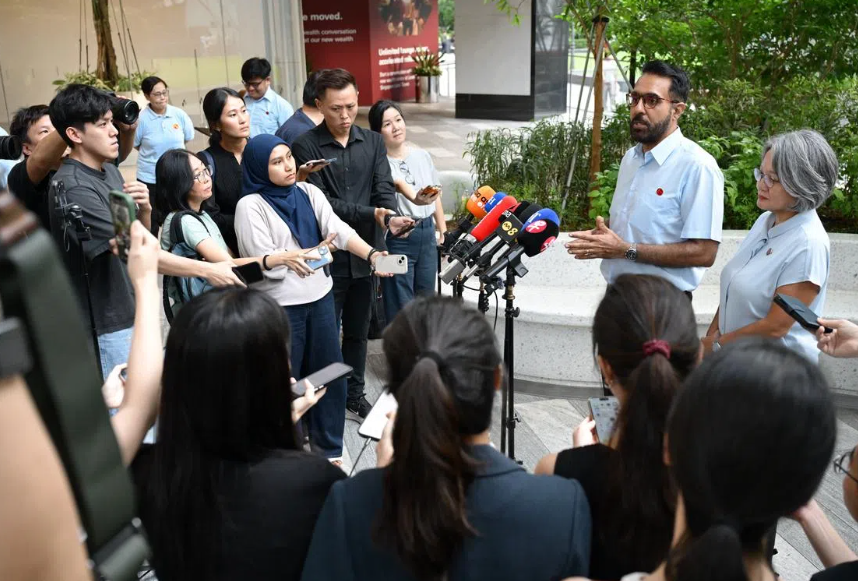
Singapore's Workers Party has decisively closed ranks behind its secretary-general Pritam Singh following a day of high-stakes internal votes that tested his leadership for the first time since taking office in 2018. After enduring a no-confidence motion and a contested party election on June 28, Singh secured the backing of 82 of 106 party cadres, effectively ending months of uncertainty within the opposition party and cementing his control over the organisation.
The internal challenge had been triggered by a group of dissident cadres who organised a special conference to hold Singh accountable for his conviction on charges of lying to Parliament. The conviction stemmed from his role in an affair involving former Sengkang GRC member Raeesah Khan, who had fabricated an account of alleged police mistreatment of a sexual assault victim during a parliamentary speech. Singh was subsequently found to have been complicit in prolonging the deception, leading to his prosecution in court and a guilty verdict upheld by the High Court in December 2025.
Those seeking to challenge Singh's continued leadership had hoped to leverage public concern about his conviction to persuade party members to demand his resignation or to find a credible rival to contest the leadership. However, the strategy ultimately foundered. While Singh faced questioning during the lengthy six-hour meetings, other cadres rose to defend him, preventing the confrontation from escalating into an inquisition. More crucially, despite efforts to recruit an alternative candidate throughout the preceding weeks, no one stepped forward to challenge him, leaving Singh to retain his position unopposed in the formal ballot.
The outcome underscores the extent to which the party hierarchy remains invested in Singh's continued leadership. Former party chief Low Thia Khiang, widely recognised as the architect of the modern Workers Party, publicly declared his support for Singh ahead of the vote, lending considerable institutional weight to the incumbent leader. Similarly, party chair Sylvia Lim, who has occupied her position for 23 years, stood alongside Singh following the vote, signalling unified leadership at the top of the organisation.
The party's disciplinary response to the underlying scandal also reflected a reluctance to inflict severe damage on Singh. Although an internal panel concluded that Singh had breached the party constitution, the leadership opted for a formal letter of reprimand rather than pursuing harsher disciplinary measures. Critics have characterised this approach as remarkably lenient given the seriousness of the conviction and its implications for public trust in parliamentary institutions. The contrast between the gravity of Singh's legal troubles and the mildness of the party's internal response has prompted observers to question whether considerations of political survival have overshadowed concerns about principle.
Yet the cadres' decision to rally behind Singh, despite their evident reservations about the scandal, suggests a calculation that the party's long-term interests are better served by maintaining continuity rather than attempting a leadership transition that might create additional instability. For an opposition party operating in Singapore's highly competitive political environment, public signs of internal division can prove extraordinarily damaging. Several opposition parties have suffered electoral setbacks following high-profile disputes over leadership or strategy, making unity a premium value for Workers Party strategists seeking to expand the party's parliamentary presence.
The Workers Party can now redirect its focus toward the work it identifies as central to its political project: expanding parliamentary representation and forcing greater scrutiny of government policies from the legislative floor. The party's performance in the May 2025 general election, contested when Singh's conviction in the lower court was already a matter of public record, provided some evidence that voters are willing to look past the scandal. The party not only retained its existing constituencies but also gained two Non-Constituency MP seats, suggesting that Singh's legal troubles had not devastated the party's electoral prospects among its existing base of supporters.
However, the question of middle-ground voter appeal remains significantly more complex. Supporters of the Workers Party tend to view the scandal through a predominantly political lens, interpreting Singh's troubles as a manifestation of government pressure rather than as a substantive issue of character and integrity. By contrast, swing voters and middle-class Singaporeans less engaged with opposition politics may harbour stronger reservations about backing a party led by someone with a parliamentary lying conviction. The distinction between core and swing electorates becomes particularly acute for opposition parties attempting to break through into constituencies where they lack an established foothold.
Lim's remarks about leadership renewal also hint at coming challenges for the party. She acknowledged that after 23 years in the chair, the party is conscious of the need to develop new leaders and suggested that future media appearances might feature different faces at the forefront of the organisation. This statement implicitly concedes that Singh's continued leadership carries a political cost that the party hopes to gradually mitigate through generational change. However, the absence of any obvious successor capable of commanding Singh's parliamentary experience or public recognition suggests that leadership renewal may proceed slowly and incrementally rather than through any dramatic acceleration.
Singh himself has offered little beyond his existing public explanations when challenged directly about his conviction. When asked how the party responds to criticism that it is led by a "convicted liar," he directed questioners to his website and reiterated that his position remains consistent with statements he has made in Parliament. This defensive posture, while politically calculated, does little to assuage concerns among voters outside the party's traditional coalition about the nature of his actions and their implications for his fitness for high office.
The Workers Party's internal consolidation around Singh reflects a pragmatic if ethically fraught assessment of political realities. Within the closed world of party politics, unity carries its own logic and momentum. Yet as the party contemplates its longer-term prospects in Singapore's intensely competitive political landscape, the question of whether it can expand beyond its existing support base while led by someone carrying the burden of a parliamentary conviction remains unresolved. The cadres may have voted to keep Singh, but the far more demanding test will come when the party confronts voters in constituencies where his conviction remains a live and contested issue.

