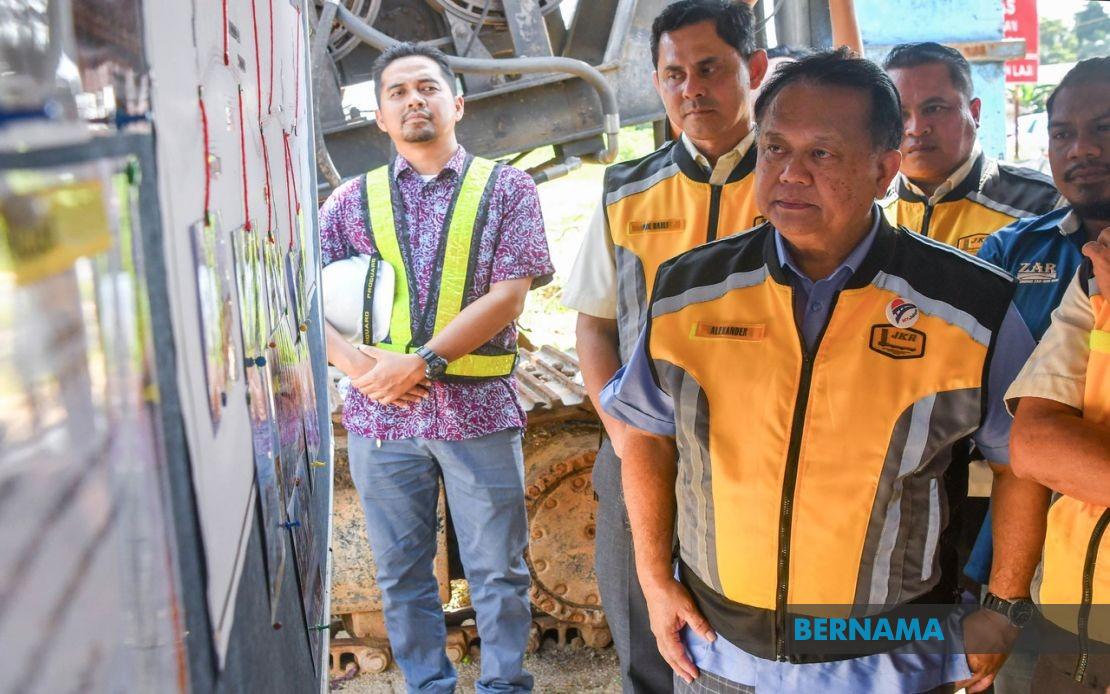
The Works Ministry has placed 50 infrastructure projects under intensive supervision as part of a coordinated effort to bring delayed work back on schedule, Works Minister Datuk Seri Alexander Nanta Linggi announced during a visit to Kelantan on July 16. These troubled projects represent a small but significant portion of the ministry's total 865 ongoing initiatives across the country, signalling both the scale of infrastructure development underway and the management challenges that accompany such ambitious portfolios.
Among the ministry's substantial commitments, Kelantan itself hosts 104 projects, of which only seven have been classified as underperforming. This regional breakdown underscores how delays are distributed unevenly across Malaysia, with some states experiencing smoother implementation than others. The identification of these 50 problematic schemes followed a comprehensive audit, reflecting the ministry's attempt to gain granular visibility into project-level performance rather than relying solely on aggregate statistics that might mask localised difficulties.
The causes of project delays reveal the complex obstacles facing infrastructure delivery in Malaysia's varied terrain and institutional landscape. Contractors facing financial strain or operational inefficiencies have emerged as a primary factor, compounded by acquisition challenges when securing land rights from multiple private owners or government entities. Utility relocation—moving power lines, water pipes, and telecommunications cables to accommodate new roads or structures—routinely disrupts schedules, whilst unforeseen subsurface conditions such as unexpected rock formations or underground obstructions discovered only during excavation add further unpredictability to timelines established during planning phases.
The ministry's approach to remedying delays demonstrates nuanced judgment rather than a one-size-fits-all policy. Projects nearing completion with merely ten to fifteen percent of work outstanding may receive extensions of time rather than face contract termination, a pragmatic calculation that recognises the cost inefficiency of abandoning near-finished work and engaging replacement contractors. This flexibility acknowledges that extending deadlines sometimes costs less than the overhead of rebidding, mobilising new teams, and managing transition periods where sites stand idle.
Weekly monitoring cycles, conducted immediately following Cabinet meetings, provide the institutional mechanism for sustained attention to underperforming schemes. By linking project reviews to the Cabinet schedule, the ministry embeds infrastructure performance into broader government governance rhythms, ensuring that challenges receive ministerial-level awareness rather than languishing in departmental reports. The deputy minister's explicit assignment to oversee sick projects nationwide signals that senior political leadership recognises the reputational stakes when infrastructure fails to meet public expectations.
The prospect of contractor removal or contract termination hangs over persistently underperforming projects, creating accountability pressure on the private sector firms undertaking construction work. However, the minister's emphasis on careful, legally compliant termination procedures reflects awareness that hasty contract cancellations invite litigation and disputes that further delay project completion and consume resources in legal proceedings rather than construction activity. This measured approach balances discipline with caution, recognising that infrastructure delays are costly but mismanaged terminations can prove equally expensive.
The FT209 and FT131 road upgrading project in Kelantan exemplifies both the significance of infrastructure investments and the challenges encountered in their execution. Valued at RM191 million and scheduled for completion in September 2025, this six-kilometre upgrading initiative directly addresses chronic traffic congestion connecting Kubang Kerian through to Pengkalan Chepa, route segments that serve both commuter traffic and commercial transport. With 71.61 percent physical progress achieved to date, the project demonstrates tangible advancement despite its overall timeline pressures.
Land acquisition for this single road project consumed more than RM200 million to secure rights over 300 individual properties, illustrating the extraordinary costs and administrative complexity involved in securing contiguous rights-of-way through developed areas. This expense, nearly double the construction contract value, underscores how Malaysian infrastructure projects frequently face cost inflation driven by property acquisition rather than construction itself—a reality that complicates budget planning and tests public patience when projects exceed initial funding estimates.
The project's environmental and social impacts have extended beyond its primary purpose, generating secondary effects that demanded ministerial intervention. Flooding affecting nearby residents emerged as an unintended consequence of construction activity, prompting the minister to instruct the contractor to immediately construct a temporary 40-metre drainage channel. This responsive measure, addressing a complaint raised by Pengkalan Chepa Member of Parliament Datuk Dr Ahmad Marzuk Shaary, demonstrates how infrastructure projects intersect with local political interests and how ministers must navigate both technical construction requirements and constituency service obligations.
The broader significance of the Works Ministry's oversight initiative extends beyond individual project management. As Malaysia pursues infrastructure-heavy development strategies intended to support economic growth, enhance connectivity, and improve quality of life, the systematic identification and remediation of project delays becomes a critical governance function. Public confidence in infrastructure delivery depends not merely on completing projects but on demonstrating competent stewardship of resources and transparent acknowledgment of challenges.
For Malaysian businesses and investors, the ministry's monitoring regime offers some assurance that contracts undertaken with government entities receive serious supervisory attention. However, the persistence of 50 troubled projects simultaneously signals that infrastructure delivery remains vulnerable to predictable challenges—contractor capacity issues, land acquisition complications, and site condition surprises—that experience has not yet eliminated. Whether the intensified weekly review cycle and threat of contractor removal will significantly improve performance trajectories remains to be seen, dependent on whether monitoring mechanisms can translate into genuine remedial action or whether they function primarily as reporting exercises.
The regional implications warrant attention as well. Southeast Asia's infrastructure ambitions have frequently encountered similar delays and cost overruns, suggesting that Malaysia's experience with sick projects reflects not unique mismanagement but systemic challenges shared across the region. How the Works Ministry addresses its portfolio of troubled projects could provide instructive lessons for other nations grappling with infrastructure delivery complications, particularly regarding the balance between flexibility in timeline extensions and firmness in contractor accountability.

