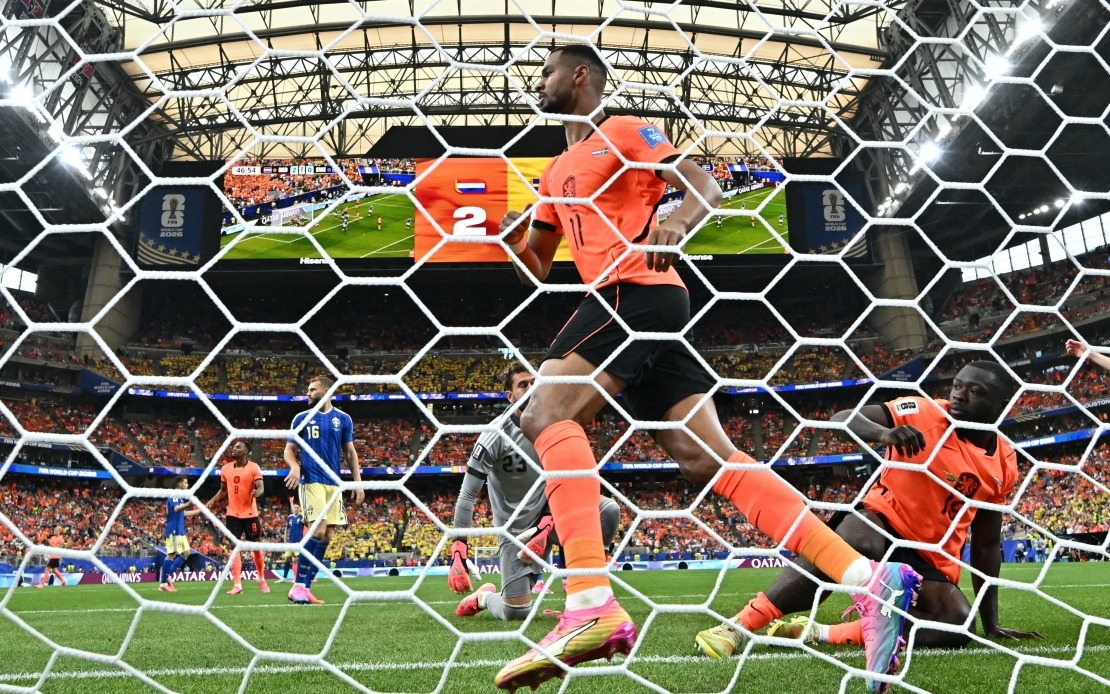
The tournament's scoring trends have captured international attention as the World Cup reached a milestone this past weekend with Dutch forward Cody Gakpo's goal in the Netherlands' emphatic 5-1 triumph against Sweden. This strike marked the 100th goal of the competition, achieved in the 33rd match played—an average of 3.03 goals per contest. The pace at which this landmark was reached represents the fastest progression toward the century mark since Switzerland hosted the tournament in 1954, when the milestone was recorded after merely 20 matches.
The achievement stands in sharp contrast to more recent World Cups. In Brazil 2014, it required 36 matches to accumulate 100 goals, while Spain 1982 reached the same figure after the same number of matches. Earlier tournaments tell a similar story: Argentina 1978 and the United States in 1994 both needed 38 matches to reach 100 goals. The current tournament's acceleration in goal-scoring has prompted analysis among football experts seeking to understand what conditions have contributed to this surge in attacking prowess.
The official tournament ball, branded the Trionda, has emerged as one potential explanation for the elevated scoring. Critics and observers have suggested that the ball's aerodynamic properties may have compromised goalkeepers' ability to accurately track and judge shots from distance, particularly long-range strikes. This design characteristic appears to have contributed meaningfully to the tally, with approximately 10 goals stemming from outside the penalty area during the competition's early stages. Such a high proportion of distant strikes would have been unusual in previous tournaments, indicating a possible mechanical advantage for shooters.
Environmental and competitive factors have also been proposed as contributing elements. The intense heat encountered during matches likely accelerates player fatigue, potentially leading to lapses in defensive concentration and positioning. Tournament organisers have instituted mandatory three-minute cooling breaks during matches, which present coaches with valuable opportunities to reorganise their tactical approaches and provide rest intervals for their squads. These stoppages may paradoxically create more attacking opportunities by allowing teams to reset their formations and make strategic adjustments designed to exploit opposition vulnerabilities.
The expansion of the tournament from 32 to 48 teams represents perhaps the most significant structural change affecting this edition. This expansion inevitably reduces the technical quality disparity that previously existed between stronger nations and weaker sides, yet initial results present a more nuanced picture than simple mathematical assumptions might suggest. Germany's dominant 7-1 destruction of Curaçao, Canada's comprehensive 6-0 dismissal of Qatar, and Tunisia's consecutive heavy losses to Sweden and Japan at 5-1 and 4-0 respectively appeared to validate concerns about lopsided scorelines.
However, subsequent matches have complicated this narrative considerably. Curaçao managed to hold Ecuador to a goalless draw, demonstrating resilience against technically superior opposition. Cabo Verde's remarkable defensive display against Spain resulted in a 0-0 stalemate that confounded expectations, while Qatar's performance against Canada proved more competitive than the final 6-0 margin suggested—the team played much of the encounter with only nine players after receiving red cards, yet still managed to limit further damage in the latter stages.
Underdogs such as Jordan and Uzbekistan have proven capable of mounting genuine resistance despite ultimately losing 3-1 to Austria and Colombia respectively. These matches were genuinely contested rather than one-sided affairs, indicating that the expanded format has not simply created a tournament of inevitable blowouts. Instead, emerging evidence suggests that the 48-team structure may be producing more unpredictable outcomes and competitive balance than anticipated during the planning phases.
The combination of these factors—the ball's technical properties, environmental conditions with scheduled cooling intervals, and the tournament's expanded team composition—appears to have created conditions favouring attacking play while simultaneously maintaining competitive balance. For Malaysian and Southeast Asian football enthusiasts, this trend carries important implications regarding player development and tactical approaches. Teams from this region attempting to compete in future World Cups will need to consider how evolving match conditions influence preparation strategies and player conditioning requirements.
The high-scoring nature of this tournament may represent a permanent shift in World Cup football dynamics, or it may prove specific to the unique circumstances of this particular edition. Regardless, the achievement of the 100-goal milestone at such an accelerated pace demonstrates how seemingly technical modifications and structural decisions can substantially alter the character and narrative of elite sports competition. As the tournament progresses, observers will continue analysing whether this rapid-fire attacking football persists throughout the knockout stages or whether more defensive pragmatism reasserts itself as competition intensifies.

