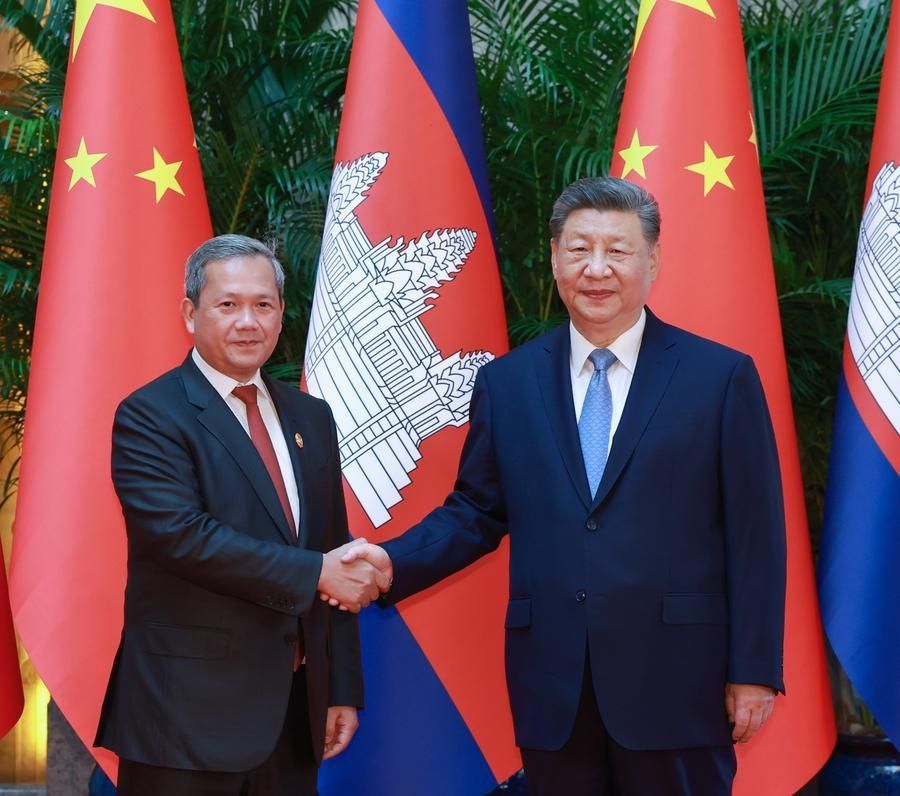
Chinese President Xi Jinping and Cambodian Prime Minister Hun Manet met in Shanghai on Friday, July 17, to reaffirm the two nations' long-standing alliance and chart a course for deepened bilateral engagement across multiple sectors. The encounter, which took place as Hun Manet attended the 2026 World Artificial Intelligence Conference and High-Level Meeting on Global AI Governance, underscored Beijing's commitment to strengthening ties with a crucial Southeast Asian partner at a time when regional geopolitics remain fluid and competition for influence intensifies.
The discussions centred on what both leaders characterised as an "ironclad friendship" inherited from previous generations of Chinese and Cambodian leadership. This rhetorical framing carries weight in Southeast Asia, where historical narratives of solidarity and resistance to external pressure shape diplomatic relationships. For Cambodia, the affirmation of this enduring bond carries particular significance given its geographic proximity to Thailand and Vietnam, historical tensions with its neighbours, and its economic dependence on Chinese investment and development assistance. Xi's emphasis on honouring this legacy serves both to reassure Cambodia of China's steadfast backing and to signal Beijing's confidence in Hun Manet's stewardship following his assumption of the premiership.
At the heart of the economic agenda lies the expansion of the "Diamond Hexagon" cooperation framework, a multi-dimensional partnership structure designed to integrate Cambodia more deeply into China's broader regional development strategy. Rather than remain confined to traditional sectors such as hydroelectric power generation and agricultural production—areas where China has long been a dominant investor and technical partner—both countries have now pivoted toward emerging domains. The explicit inclusion of artificial intelligence and digital economy development reflects a recognition that Cambodia's economic future depends not merely on resource extraction or labour-intensive manufacturing, but on technological adoption and digital infrastructure capable of supporting modern supply chains and services.
Central to this vision is the acceleration of two specific development corridors: the Industrial Development Corridor and the Fish and Rice Corridor. These initiatives aim to create integrated economic zones that would facilitate goods movement, labour mobility, and knowledge transfer across their shared border. For Malaysian observers, these corridors warrant careful attention, as they represent China's methodical approach to binding Southeast Asian economies into its development orbit through infrastructure that creates lasting interdependencies. The corridors essentially lock countries into patterns of trade and investment that become difficult to unwind, reinforcing Beijing's influence over Phnom Penh's strategic choices.
Transnational crime cooperation emerged as another substantive pillar of the partnership. Xi highlighted the need for coordinated action against counterfeiting, smuggling, online gambling, and telecommunications fraud—issues that plague the entire Southeast Asian region and exact significant costs on economies from Malaysia to Thailand to Cambodia itself. The prevalence of scam operations run from border zones and the flow of counterfeit goods through the region create security challenges that no single nation can address in isolation. By positioning China and Cambodia as partners in law enforcement, Xi simultaneously strengthened bilateral bonds and positioned Beijing as a responsible regional actor concerned with stability and rule of law, even as critics argue that Chinese enforcement efforts are selective and sometimes serve strategic interests.
Perhaps most diplomatically delicate was Xi's treatment of Cambodia-Thailand border tensions. Rather than position China as mediator in a neutral capacity, Xi explicitly stated that Beijing "supports Cambodia and Thailand in finding a solution through dialogue and consultation" whilst reserving the right to "continue playing a constructive role." This phrasing maintains Chinese influence over the peace process without appearing to impose solutions or take sides overtly. For Southeast Asia writ large, this illustrates how major powers embed themselves within regional disputes—not by direct intervention but through the architecture of mediation itself, which grants them voice in outcomes that affect smaller neighbours.
Hun Manet's response reaffirmed Cambodia's unwavering commitment to the one-China policy and pledged to deepen political trust with Beijing whilst expanding bilateral trade and cooperation on infrastructure megaprojects. His gratitude for Chinese economic assistance reflected the genuine dependency Cambodia has developed on Chinese capital, which now funds roads, ports, dams, and industrial zones across the kingdom. This structural asymmetry—where Cambodia requires Chinese investment far more than China requires Cambodian goods or resources—fundamentally shapes their relationship and limits Phnom Penh's negotiating leverage on any issue Beijing deems important.
The convergence of voices on telecommunications fraud deserves particular emphasis for Malaysian audiences, as this scourge affects the entire region and originates significantly from network nodes operating across Southeast Asia's porous borders. Chinese and Cambodian cooperation on this front could yield meaningful security gains, though success depends on Cambodia's capacity to enforce laws and China's willingness to pursue suspects regardless of their nationality or connections to organised crime networks with murky links to state or party interests.
The timing of this meeting—during an international conference on artificial intelligence governance—signals that both countries recognise Cambodia's need to leapfrog development stages and adopt emerging technologies rather than remain perpetually locked into resource extraction and agricultural commodity production. For Malaysia, which has positioned itself as a regional technology and financial hub, this represents implicit competition. Cambodia's pivot toward AI and digital economy development, backed by Chinese capital and expertise, could gradually shift regional competitive dynamics and alter the geography of technological advantage in Southeast Asia.
Broadly, the Shanghai meeting exemplifies how Beijing pursues influence in Southeast Asia through sustained, multifaceted engagement that combines economic incentives, infrastructure development, security cooperation, and diplomatic reassurance. Cambodia, for its part, has largely accepted the strategic logic of deepening ties with China whilst maintaining nominal relationships with other powers. The success of this partnership will depend on whether economic cooperation generates tangible improvements in Cambodian living standards and whether infrastructure investment translates into sustainable development rather than debt-trap dynamics that ultimately constrain national autonomy.
For the broader region, the consolidation of China-Cambodia ties underscores a larger pattern: as ASEAN members pursue their own development imperatives, many find themselves drawn into closer partnerships with Beijing, whether by calculation, necessity, or both. The challenge for other regional players, including Malaysia, lies in demonstrating that alternative partnerships and development models offer comparable or superior value propositions—a task that becomes increasingly difficult as Chinese investment, technology, and market access prove indispensable to growth.

