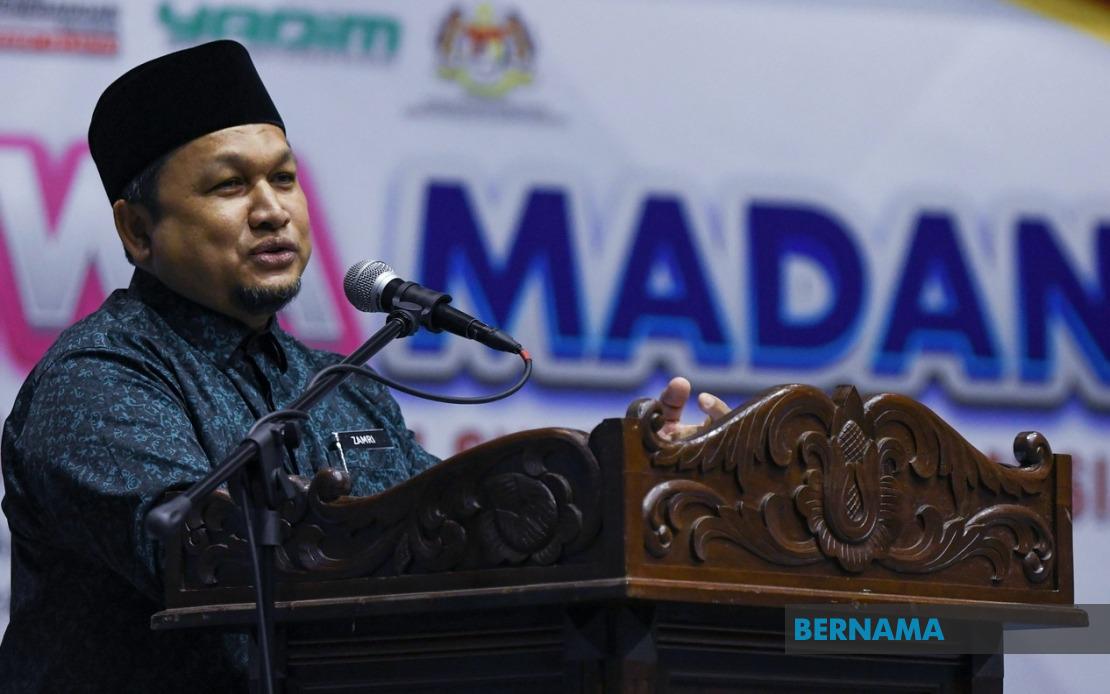
The Malaysian government's push to establish clearer accreditation requirements for religious speakers active on digital platforms has won backing from a key Islamic institution, signalling a coordinated effort to maintain doctrinal standards in increasingly crowded online spaces. Yayasan Dakwah Islamiah Malaysia, the state-backed dakwah agency operating under the Prime Minister's Department, has endorsed the initiative, which was recently announced by the Minister in the Prime Minister's Department (Religious Affairs) Dr Zulkifli Hasan. The foundation's chief executive officer Zamri Zainal Abidin framed the proposal not as a restriction on religious discourse but as a necessary safeguard for the integrity of Islamic teaching in the digital age.
The core rationale underpinning this initiative addresses a genuine challenge facing religious authorities across Malaysia and the broader Southeast Asian region. Social media platforms have democratised religious teaching, allowing virtually anyone to present themselves as an authority on Islamic matters, regardless of formal training or theological grounding. This proliferation of unqualified voices has created a marketplace of competing religious interpretations, some accurate and others potentially misleading. Young people particularly have come to rely heavily on social media for religious guidance, making them vulnerable to misinformation that could distort their understanding of faith principles or exploit their trust through charismatic but poorly-informed preaching.
Zamri emphasised that without a structured accreditation system, the public sphere becomes vulnerable to the distortion of religious facts. He noted that individuals without substantive Islamic knowledge can claim credentials as an "ustaz" or preacher, establishing apparent authority that they have not earned through rigorous study. This gap between appearance and substance represents a threat not merely to individual believers but to the collective confidence that communities place in religious institutions. When people encounter contradictory religious guidance online, trust in legitimate religious authorities can erode, creating a vacuum that fringe voices or bad-faith actors may exploit.
The proposal reflects a broader pattern of governments in Muslim-majority nations attempting to maintain oversight of religious discourse in an era when traditional gatekeepers have lost monopolistic control over information dissemination. Malaysia's approach differs from more restrictive models by framing accreditation as a credentialing system rather than outright censorship. The distinction matters because it suggests that the system aims to elevate qualified speakers rather than silence critics, though the practical implementation will ultimately determine whether that promise holds true. Other countries in the region have grappled with similar tensions between protecting doctrinal standards and preserving space for diverse religious voices.
YADIM's endorsement carries particular weight because the foundation itself operates an accreditation system for religious educators, particularly through its Daie Muda programme. Speakers trained through YADIM receive formal credentials from the Federal Territories Mufti Department, providing a model that could be expanded nationally. This existing infrastructure suggests that Malaysia possesses both the institutional capacity and practical experience to implement accreditation standards relatively smoothly. By positioning YADIM as a "strategic partner" in realising the government's initiative, Zamri indicated that the foundation stands ready to extend its current systems to encompass online preachers beyond its traditional networks.
The timing of this initiative reflects growing government concern about the proliferation of religious content of variable quality across Malaysian social media. The speed with which misinformation spreads online, particularly content that could inflame religious sensitivities, has prompted religious authorities to consider whether existing regulatory frameworks adequately address modern realities. An accreditation system could theoretically enable citizens to distinguish between speakers with formal training and those operating without theological preparation, though implementation questions remain. How such a system would actually operate—whether through voluntary participation, incentivised adoption, or more coercive measures—has not been detailed.
Critics might argue that accreditation systems carry inherent risks of centralising religious authority and potentially excluding legitimate voices that fall outside mainstream institutional frameworks. The government would need to navigate carefully between protecting doctrinal integrity and preserving the pluralistic space within Islam that allows different scholarly schools and interpretative approaches to coexist. Religious diversity within Malaysia's Muslim community, including different madhabs and theological emphases, complicates the question of who should determine which speakers deserve accreditation. The framework would require inclusive governance structures that prevent any single theological perspective from monopolising legitimacy.
From a practical standpoint, accreditation for online preachers presents enforcement challenges that offline systems do not face. Social media's borderless nature means that speakers based outside Malaysia could still reach Malaysian audiences, complicating any national accreditation regime. Individuals could potentially circumvent requirements by operating under pseudonyms or shifting platforms. Additionally, the definition of who constitutes an "online preacher" worthy of accreditation remains unclear—does the system apply only to those who explicitly market themselves as religious educators, or anyone discussing Islamic matters with audiences? Such definitional questions will likely generate considerable debate during implementation.
For Malaysian readers and Southeast Asian observers, this development signals an escalating effort by governments to shape religious discourse in the digital sphere. It reflects broader global trends in which authorities increasingly view online religious content as deserving the same regulatory attention traditionally applied to mosques, schools, and published works. Whether such oversight ultimately strengthens public confidence in religious institutions or whether it provokes backlash from communities who view accreditation as governmental overreach into matters of faith remains an open question. The framework's ultimate success will depend heavily on how transparently it operates, how inclusively it treats different Islamic scholarly traditions, and whether it genuinely focuses on credential verification rather than ideological policing.

