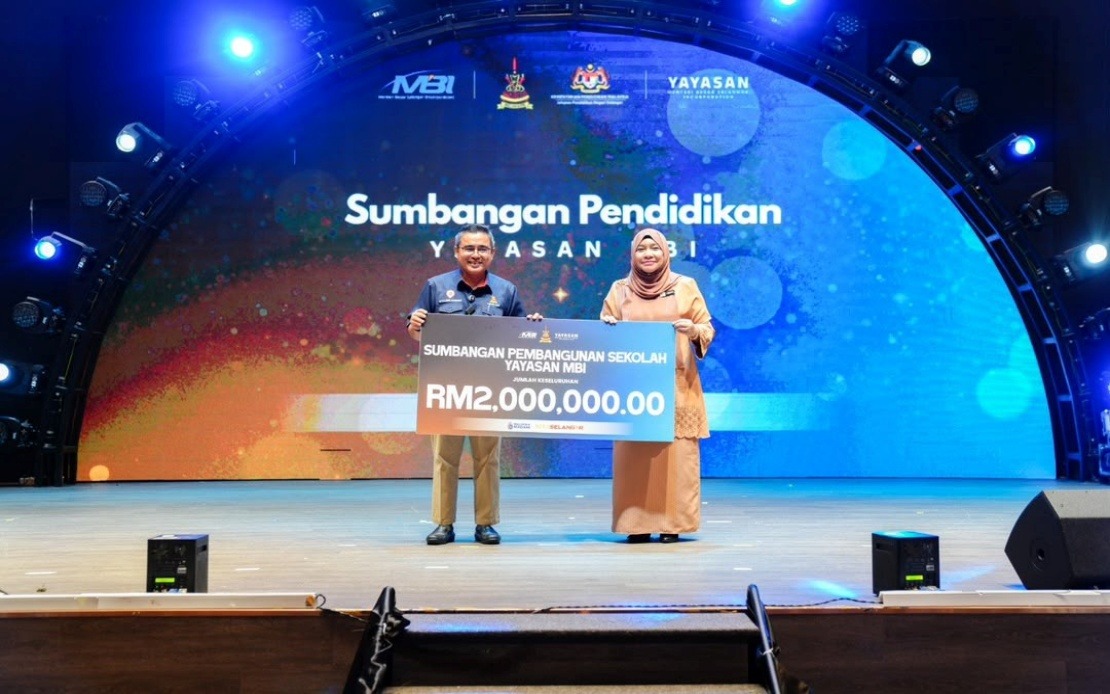
The Yayasan Menteri Besar Selangor (Incorporated), commonly known as Yayasan MBI, has channelled RM2 million into its School Development Contribution initiative, marking another significant step in its mission to enhance educational standards across Selangor. The funding represents the foundation's sustained commitment to transforming school environments and ensuring that both students and educators have access to improved facilities that foster better teaching and learning outcomes.
According to the foundation's leadership, this investment goes beyond traditional notions of charitable assistance. Ahmad Azri Zainal Nor, the head of Yayasan MBI, framed education investment as a fundamental strategy for building human capital and securing Selangor's long-term development prospects. By channelling resources directly into schools and learning institutions, the foundation positions itself as a strategic partner in realising the state's educational ambitions rather than merely providing temporary relief.
The disbursement was formally announced during the Yayasan MBI Education Aspiration 2026 event, a gathering that served multiple purposes beyond the funding announcement. The occasion provided an opportunity to strengthen collaboration between various stakeholders in Selangor's education landscape and to acknowledge the dedication of teachers and educators who form the backbone of the schooling system. Such recognition is crucial in a sector where professional commitment often goes unsung despite its critical importance to society.
Yayasan MBI's educational programming reflects a comprehensive and multi-layered approach to improving access and quality across Selangor's schools. The foundation operates several flagship programmes, including the Back to School Tour, which reaches students during crucial transition periods. Beyond this, partnerships with Parent-Teacher Associations provide grassroots engagement, while the Selangor People's Tuition Programme offers free academic support to students who might otherwise struggle with core subjects. The Didik Kasih Programme extends this reach further, ensuring that learning assistance extends to those most in need.
The significance of these initiatives lies in their targeted nature. Rather than spreading resources thinly across generic welfare activities, Yayasan MBI has developed a portfolio of interventions designed to address specific gaps in Selangor's education system. Free tuition programmes particularly matter in the Malaysian context, where household budgets in lower-income communities often struggle to accommodate private tutoring costs that have become increasingly commonplace as academic competition intensifies. By providing such services at no cost, the foundation helps level the playing field for students from disadvantaged backgrounds.
Coordination with the Selangor State Education Department underscores an important principle: effective charitable work requires alignment with government structures and an understanding of actual on-ground needs. By working closely with JPNS, Yayasan MBI ensures that its initiatives complement rather than duplicate existing government programmes, and that resources reach schools and communities with the greatest need. This collaborative approach reduces inefficiency and maximises the impact of every ringgit spent.
For Malaysian education policy observers, Yayasan MBI's approach offers valuable lessons about the role that non-governmental actors can play in supplementing public education systems. While the government bears primary responsibility for providing quality schooling, state-linked foundations can identify gaps and pilot innovative approaches that eventually influence broader policy. The foundation's programmes serve as testbeds for interventions that, if successful, might inform state or national education strategies.
The foundation's emphasis on infrastructure and facilities also addresses a real problem across many Malaysian schools. While spending on physical infrastructure may seem less glamorous than curriculum innovation, quality learning spaces have demonstrable effects on student engagement and achievement. Well-maintained buildings, functional classrooms, adequate libraries, and proper sports facilities contribute to an environment where students are more motivated to attend school regularly and participate actively in learning.
Selangor's position as Malaysia's most urbanised and economically developed state means that educational inequality within the state can be stark. While affluent areas enjoy well-funded private schools and robust public institutions, pockets of poverty persist in older towns and fringe settlements where school infrastructure lags. Yayasan MBI's interventions help bridge this gap, though the RM2 million allocation, while substantial, can only address a fraction of the true need across the state's thousands of schools.
Looking forward, the foundation's commitment to education through 2026 suggests continuity and long-term thinking. Sustainable educational improvement requires consistent funding and commitment over years, not one-off gestures. By framing its work through a specific timeline and demonstrating regular disbursements, Yayasan MBI signals to schools, educators, and communities that they can rely on ongoing support for development initiatives.
The broader implications for Southeast Asia are relevant too. As regional economies increasingly depend on high-skill workforces, supplementing public education through strategic philanthropic investment becomes more important. Selangor's model of state-linked foundations working in concert with education departments offers a template that other Malaysian states and neighbouring countries might adapt. Whether such cooperation can be sustained and scaled across wider education systems remains a question that policymakers will need to address in coming years.

