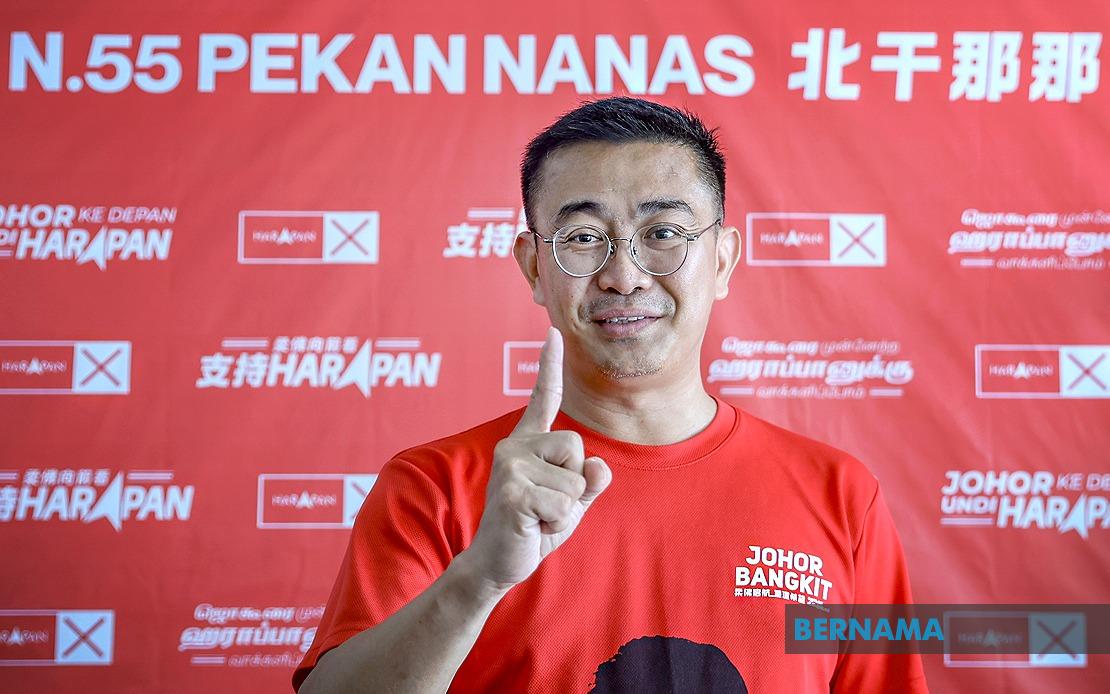
Pakatan Harapan candidate Yeo Tung Siong is making a determined push to retake the Pekan Nanas state constituency in Johor's latest election, betting heavily on his two-term record as assemblyman and claiming substantial grassroots support among local voters. Speaking from Pontian, the former representative expressed confidence that his decade-long tenure representing the area from 2013 to 2022 provides solid credentials for a political comeback, even as he faces an incumbent from Barisan Nasional in what has shaped into a direct contest.
Yeo's optimism stems partly from what he characterises as exceptionally positive feedback during his campaign phase. The former discipline teacher and vice-principal estimates having met approximately 60 per cent of the constituency's electorate through an extensive ground operation spanning walkabouts, community talks, group meetings, door-to-door visits, and engagements at public markets, flea markets and food establishments. This grassroots approach reflects a calculation that sustained personal contact and accessibility can translate into renewed voter confidence, particularly among constituents familiar with his previous work.
Centrally, Yeo's pitch to voters rests on demonstrated service delivery rather than rhetorical promises. He recalls securing RM500,000 in allocation to address a chronic flooding issue by straightening the flow of the Pulai River, a problem that had plagued residents for years. Beyond flood mitigation, he collaborated with the private sector on infrastructure at Kampung Melayu Raya, showing willingness to work across sectors. These tangible interventions form the backbone of his argument that prior performance justifies re-election, particularly among voters concerned with practical governance and visible improvement.
Yeo's accessibility record also features prominently in his campaign messaging. Rather than emphasising ceremonial aspects of elected office, he frames his approach as non-bureaucratic and responsive, pledging that constituents can contact him directly and receive personal attention. For a politician seeking to distinguish himself from an incumbent, this positioning as approachable and solution-oriented may resonate in communities where residents feel distant from their representatives.
Traffic congestion and employment prospects have emerged as the dominant voter concerns throughout his campaigning, issues that resonate across Malaysia's Johor as the state experiences rapid urbanisation and population movements between towns. Yeo has identified two shortcut routes as priority projects should he regain his seat: one connecting Ulu Pulai to Pekan Nanas and another linking Pulai to Sri Bunian junction. These roads are promoted as capable of substantially reducing travel times between Pontian and Johor Bahru, addressing complaints from commuters and potentially improving economic connectivity for the district.
Unemployment and livelihood opportunities form the second pillar of his campaign platform. Yeo proposes reviving career carnivals that operated during his previous tenure, working with major employers in the Pekan Nanas region to create direct pathways for local job seekers. This initiative targets youth and job-seeking families, a demographic segment crucial in state elections and increasingly concerned about wage growth and career prospects in smaller towns outside major urban centres.
Social welfare provision represents a third focus area. Yeo indicates an intention to ensure better coordination between residents needing assistance and relevant government bodies including the Social Welfare Department (JKM) and the Social Security Organisation (SOCSO), suggesting that improved administrative linkage can enhance welfare outcomes. This emphasis on facilitating access to existing schemes rather than proposing new expenditures reflects pragmatic positioning given budgetary constraints faced by state governments.
The Pekan Nanas contest encapsulates broader dynamics within Johor's political landscape, where Pakatan Harapan continues efforts to regain ground lost in previous cycles. The one-on-one nature of the race against incumbent Tan Eng Meng from Barisan Nasional simplifies voter choice but intensifies the stakes for both campaigns. In such binary contests, demonstrated track records and accessibility claims become especially significant differentiators, as voters weigh incumbent performance against challenger credentials.
Yeo's gambit reflects a common pattern among returning candidates: leveraging prior service while portraying the incumbent as having lost touch or underperformed. Whether this strategy succeeds depends on whether Pekan Nanas voters prioritise continuity with proven service or prefer to evaluate the incumbent's record and performance over the intervening years. The substantial voter contact claimed by Yeo suggests his campaign believes sufficient dissatisfaction exists to reverse the 2022 outcome, though quantifying such sentiment remains challenging until actual voting occurs. In the context of competitive Johor elections where seat margins frequently narrow, Yeo's grassroots engagement may prove decisive among the persuadable middle of the electorate.

