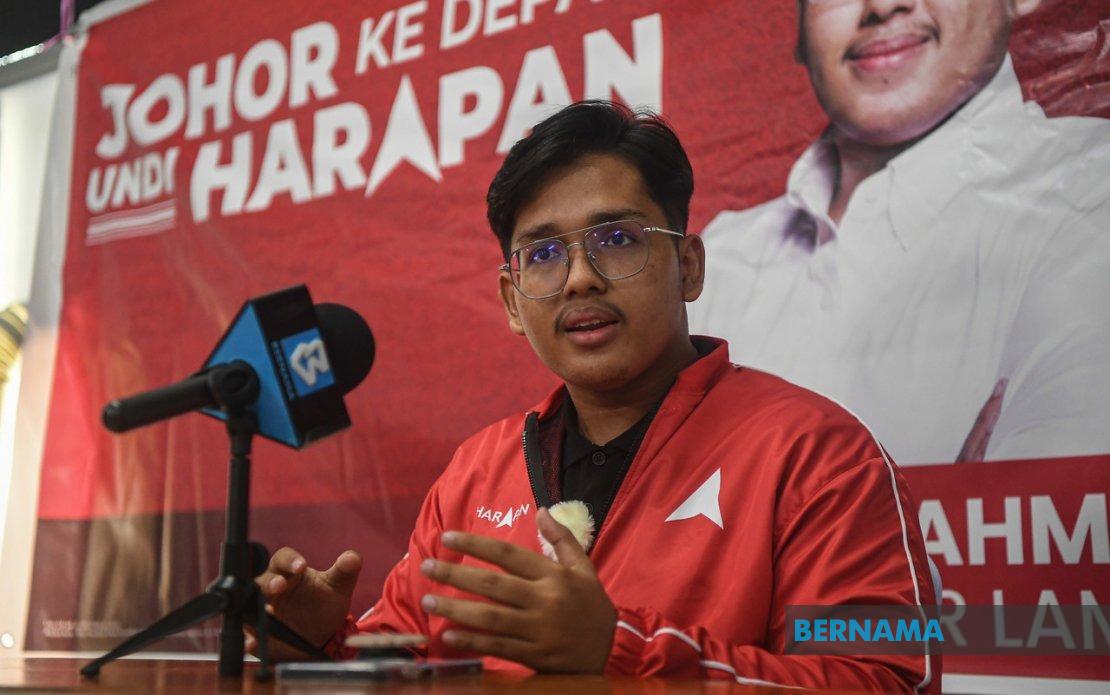
The youngest challenger in the 16th Johor state election, Danish Hossman Abd Rahman, has channelled positive community reception in the Johor Lama constituency into a strategy focused on bringing tangible development to the area. The 23-year-old Pakatan Harapan (PH) representative has cited his extensive ground engagement as evidence that voters, particularly older demographics, are receptive to his youthful energy and commitment to substantive change rather than political theatre.
Danish Hossman, a Master of Information Technology student at Universiti Tun Hussein Onn Malaysia (UTHM), has distinguished his campaign by engaging directly with constituent groups across multiple socioeconomic layers. His repeated field visits have generated what he describes as genuine enthusiasm among voters who express frustration with incumbent representatives perceived as disconnected from community concerns. This approach reflects a broader pattern in Malaysian electoral politics where younger candidates attempt to overcome experience deficits by emphasising accessibility and attentiveness to voter grievances.
The candidate's appeal among veteran voters reveals a potentially significant demographic trend in this election cycle. Older constituents have expressed appreciation for Hossman's sincerity and willingness to conduct face-to-face consultations rather than relying on distant political machinery. Many have articulated weariness toward leaders of comparable or greater age whom they perceive as having become institutionalised and detached from ground-level problems. This generational fatigue with establishment figures suggests that even in a three-way contest, voter sentiment may shift toward candidates demonstrating visible commitment to constituency work.
Rather than presenting youth as an inherent qualification for leadership, Hossman has adopted a more nuanced positioning by framing himself as a "strategic bridge" connecting historical experience with contemporary aspirations. This rhetorical stance attempts to neutralise the obvious liability of limited political background by arguing that he neither dismisses established knowledge nor defers uncritically to seniority. Such positioning acknowledges that Malaysian voters, particularly older ones, value demonstrated understanding of governance complexities while simultaneously seeking representatives who prioritise their immediate concerns.
As the campaign enters its final week, Hossman has intensified his efforts across multiple constituency segments, including targeted outreach to youth, women, and small business owners. His strategy encompasses not singular contact points but repeated interactions designed to build familiarity and establish credibility through sustained engagement. This labour-intensive approach suggests confidence in personal appeal while implicitly critiquing competitors for insufficient grassroots presence. The emphasis on multiple visits underscores a deliberate choice to prioritise relationship-building over media-centric campaigning.
Hossman has identified housing affordability and employment scarcity as the constituency's primary economic challenges, noting that inadequate opportunity drives young people toward urban centres and external markets. This diagnosis reflects realities across much of Peninsular Malaysia's secondary towns, where limited local employment options and high property costs create conditions favouring out-migration of working-age populations. The candidate's acknowledgement of this structural problem demonstrates awareness of constituencies' economic vulnerabilities and implicit criticism of past administrations for failing to address these systemic issues.
His proposed response centres on attracting investment and developing downstream industries aligned with Johor Lama's existing economic foundations, particularly agriculture and livestock production. Rather than proposing wholesale economic transformation, this approach leverages the constituency's comparative advantages while positioning enhanced agricultural value chains as employment generation mechanisms. The strategy reflects understanding that competitive advantage in rural-adjacent constituencies often derives from optimising traditional sectors rather than introducing entirely novel industries.
Danish Hossman has explicitly framed his economic vision around providing young people genuine alternatives to out-migration. He articulates the goal of enabling career construction, family establishment, and future building within Johor Lama itself. This reframing of employment policy as existential opportunity speaks to growing anxieties among younger Malaysians about intergenerational economic prospects and residential rootedness. His emphasis on choice and agency, rather than merely wage increases, suggests sensitivity to broader aspirational concerns beyond income supplementation.
The Johor Lama contest has evolved into a three-way competition among Hossman representing Pakatan Harapan, incumbent Norlizah Noh from Barisan Nasional (BN), and Aisah Esa fielded by Perikatan Nasional (PN). This three-cornered dynamic potentially benefits the youngest candidate if opposition to the incumbent becomes sufficiently consolidated. Norlizah Noh's tenure provides a natural focal point for change-oriented messaging, while PN's presence fragments anti-incumbency votes that might otherwise coalesce behind established opposition structures.
Hossman's campaign messaging deliberately eschews personal attacks and political antagonism, instead appealing for voter evaluation based on demonstrated capability and substantive policy proposals. This positioning attempts to differentiate his candidacy in an electoral environment often dominated by partisan confrontation and personal character disputes. By encouraging issue-focused assessment, he implicitly challenges both established competitors to elevate campaign discourse while creating rhetorical space where his relative inexperience becomes less salient than his policy clarity.
The 16th Johor state election encompasses 172 candidates competing across 56 seats, situating Johor Lama as one contested area within a larger electoral battleground determining the state's political direction. Early voting preceded the main election day, with results determining whether Pakatan Harapan could expand representation in a state where political control remains contested. Hossman's performance would carry implications beyond Johor Lama itself, potentially signalling broader receptiveness among Malaysian voters to younger candidates positioned as reformist alternatives to entrenched political establishments.

