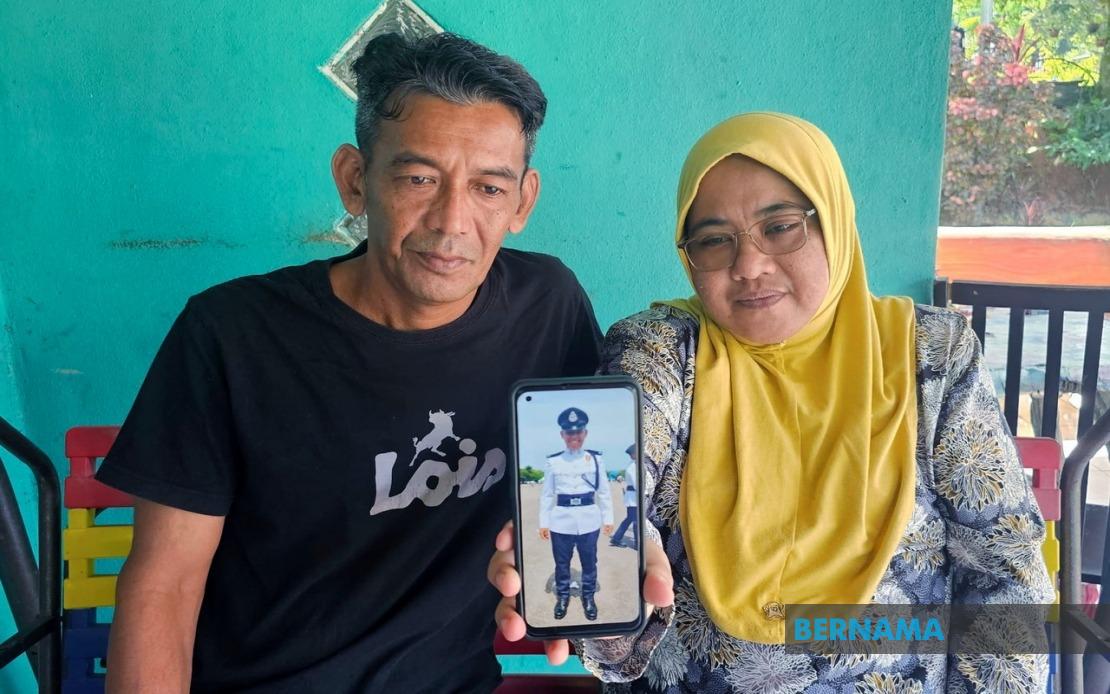
A tragedy has shattered the hopes of a Terengganu family who were counting the days until their son would finally return home for leave. Constable Muhammad Raimi Ismarubee, a 26-year-old policeman stationed in Sabah, died in an electrocution incident while on duty, leaving his parents reeling from the sudden loss of a son whose homecoming had been delayed by months of careful planning.
The incident occurred outside Weston Police Station near Sekolah Kebangsaan Weston in Beaufort, Sabah, claiming the lives of three police personnel in a single tragic moment. Alongside Muhammad Raimi, Corporal Chiu Teck Siong, 40, and Lance Corporal Mohamad Nur Hafiz Ibrahim, 29, were also electrocuted while moving a metal pole used for harvesting coconuts. The deaths underscore the occupational hazards that frontline personnel face beyond the typical scope of their duties, and raise questions about workplace safety protocols at police stations across the country.
Ismarubee Ismail, Muhammad Raimi's father, recalled receiving the devastating news on the evening of August 6. Working as a labourer, the 51-year-old was processing the shock when informed that his son had passed away at 6 pm. The timing made the loss even more poignant—just four hours earlier, Muhammad Raimi had sent a WhatsApp message updating his family about a successful drug arrest operation, his routine message revealing nothing of the tragedy that would unfold within hours.
The young constable had been employed at Weston Police Station since September 2024, barely nine months before his death. Though stationed far from home in the eastern coast of Peninsular Malaysia, Muhammad Raimi maintained close contact with his family, regularly sending money to support his younger siblings' education and purchasing necessities they required for their studies. His contribution to his household extended beyond financial support—he was deeply invested in his family's welfare and milestones, embodying a sense of duty that characterised his character both in uniform and at home.
Since joining the force, Muhammad Raimi had managed only one home visit, returning to Felda Kerteh 2 in Dungun during January. The months following had been consumed by his work obligations in Sabah, and while he harboured hopes of taking leave, he had been strategically postponing his trip home in search of more affordable flight options. In June, he had mentioned to his parents his desire to return, though he had not yet committed to a specific date. This indecision, driven by practical financial considerations, meant that his long-awaited reunion with his parents and two siblings would never materialise.
Muhammad Raimi's mother, Nor Azila Zakaria, 46, spoke of a son whose future was carefully mapped out. He had expressed intentions to become engaged to a young woman from Sabah in the following year, a relationship that represented a significant milestone in his life. Yet he had determined to delay marriage until his youngest sibling completed the Sijil Pelajaran Malaysia examination, demonstrating a maturity and sense of familial responsibility uncommon in young adults who might prioritise personal life events over family obligations.
Nor Azila recounted her son's generosity and dedication to his family's advancement. Beyond monetary assistance, Muhammad Raimi had purchased a laptop for his siblings' studies, understanding that access to technology was crucial for their educational success. This pattern of sacrifice—earning a salary in a demanding profession while prioritising his siblings' academic development—reveals a young man committed to lifting his family forward, motivated by values instilled in him during his upbringing in a Felda settlement community.
The loss extends beyond one family's private grief. The incident at Weston Police Station represents a concerning safety gap in how auxiliary duties are managed at police facilities. The task of moving a metal coconut-harvesting pole—a responsibility typically unrelated to core policing functions—resulted in the deaths of three trained officers. This raises critical questions about risk assessment, safety equipment, and training protocols when personnel undertake such tasks, particularly in environments where electrical hazards may not be immediately apparent.
For Malaysian police personnel and their families across the nation, Muhammad Raimi's death serves as a sobering reminder of the multifaceted dangers inherent in police work. While officers are trained and equipped for confronting criminal threats, workplace hazards arising from routine operational duties remain an underaddressed occupational health concern. The incident occurred in an environment typically considered administrative, suggesting that complacency regarding safety may pervade even the most familiar surroundings.
The Ismail family's tragedy reflects broader vulnerabilities facing Malaysian police personnel, particularly younger officers serving in rural or distant postings who remain separated from their support networks. Muhammad Raimi's commitment to his role and his family's welfare made the waste of his potential all the more poignant. His remains were returned home to Felda Kerteh 2, where he was buried at the local Muslim cemetery on the same day the news reached his devastated parents, the swift funeral rites providing little solace for a family robbed of their son's promised future.
This incident demands renewed attention to occupational safety standards across police stations nationwide. As investigations proceed into the circumstances surrounding the electrocution, authorities must examine not only the immediate cause but the systemic vulnerabilities that allowed three officers to face lethal risk while performing non-core duties. For families like the Ismails, whose son's homecoming will never arrive, such scrutiny may offer scant comfort, yet it remains essential that his death and those of his colleagues catalyse meaningful improvements in how police institutions prioritise worker safety.

