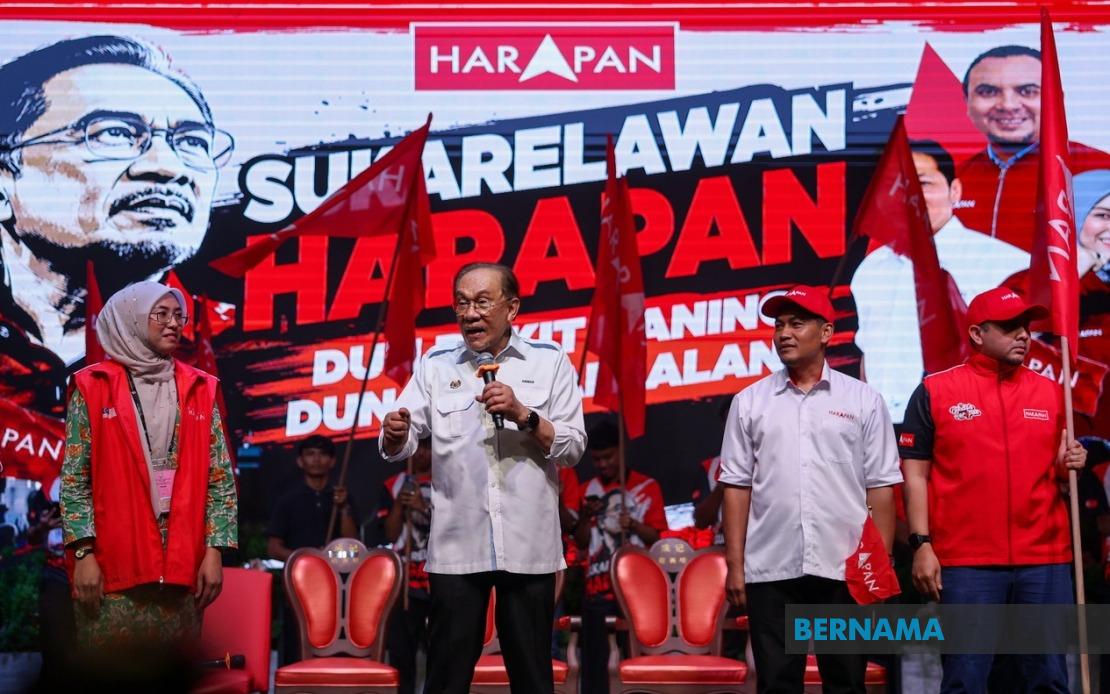
Prime Minister Datuk Seri Anwar Ibrahim has challenged young voters to break free from divisive racial politics by using the forthcoming Johor state election as an opportunity to elect representatives genuinely committed to improving their lives. Speaking at a volunteer programme launch in Muar, Anwar positioned the upcoming polls as a pivotal moment for Malaysia's younger generation to take control of their political destiny and move the nation beyond the exhausted narratives of the past.
The Pakatan Harapan chairman directly confronted the persistent tendency in Malaysian politics to weaponise ethnic identity, accusing certain political forces of deliberately stoking fear and resentment among different communities. He characterised efforts to inflame Chinese, Indian and Malay grievances as a deliberate distraction that serves only the interests of those in power who exploit communal division to consolidate their own wealth and influence. This framing represents Anwar's attempt to reposition electoral competition around governance competence and developmental outcomes rather than the traditional fault lines of race and religion that have dominated Malaysian political discourse for decades.
Addressing the youth directly, Anwar made an explicit appeal across ethnic lines, particularly to young Malays, Chinese and Indians to recognise their shared interests in meaningful employment, quality education and equitable economic opportunities. His argument hinges on the proposition that practical concerns transcend ethnic boundaries, and that voters across all communities would benefit from prioritising leaders with track records in delivering tangible improvements to living standards. This universalist approach contrasts sharply with campaign strategies that amplify communal anxieties and appeal to voters primarily through appeals to group identity.
The Prime Minister characterised the political narratives promoting ethnic suspicion as poison that corrodes the social cohesion upon which Malaysia's stability depends. He described such messaging as sabotage against national unity, framing divisive politics not merely as an electoral tactic but as a fundamental threat to the country's foundational strength. By positioning inclusive politics as patriotic and divisive politics as betrayal, Anwar attempted to morally delegitimise opponents who rely on communal messaging while claiming the moral high ground for Pakatan Harapan's approach.
The scale of youth participation at the Muar event clearly energised Anwar, who drew connections between generational turnout and the possibility of systemic political change. He suggested that younger voters represent a departure from older patterns of acquiescence, noting that a decade of campaigning had never produced scenes comparable to the enthusiasm demonstrated at this particular gathering. This observation carries weight given Malaysia's historical patterns of youth political engagement and may signal genuine shifts in how younger voters evaluate their electoral choices.
Anwar's emphasis on youth agency and responsibility extended beyond mere voting participation to encompassing broader grassroots organising. He explicitly called on young people to become community advocates, visiting neighbourhoods and districts to articulate the case for transformative change. This framing positions young voters not as passive consumers of political messaging but as active agents capable of reshaping electoral outcomes through direct engagement with their peers and communities.
The Johor election itself, scheduled for July 11 with early voting on July 7, encompasses 172 candidates competing for 56 state seats. The contest carries particular significance given Johor's historical importance within Malaysian politics and its substantial representation within the federal parliament. A strong performance by Pakatan Harapan in Johor would substantially strengthen Anwar's position both within the ruling coalition and in relation to rival factions within his own party, making the state polls far more consequential than a typical state-level contest.
Anwar's invocation of Malaysia's multiethnic character and successful historical coexistence served to reinforce his argument that racial division represents a regression rather than an inevitable feature of Malaysian society. By noting that Malays, Chinese, Indians and Orang Asli have maintained peaceful coexistence and mutual respect, he attempted to position inclusive politics as both practically achievable and morally consonant with Malaysian experience. This appeal to historical precedent aims to undermine arguments that racial appeal constitutes political necessity.
The participation of Pakatan Harapan candidates such as Nazri Abd Rahman for Simpang Jeram and Md Ysahrudin Kusni for Bukit Naning provided a ground-level counterweight to Anwar's national-level messaging. These candidates represent the specific faces through which voters will evaluate Pakatan Harapan's philosophical positions on competence, development and inclusive governance. Their presence alongside the Prime Minister signalled party unity around these themes even as internal factional tensions within Pakatan Harapan continue to simmer beneath the surface.
For Malaysian observers, Anwar's rhetoric reflects a deliberate strategic gamble that sufficient portions of the electorate, particularly younger voters, have grown weary of traditional racial appeals and are receptive to messengers emphasising practical governance and material improvement. Whether this positioning proves electorally effective will depend partly on whether Pakatan Harapan candidates can credibly demonstrate superior competence in addressing the specific concerns Anwar identified—education quality, job creation and developmental equity. The Johor polls will provide empirical evidence regarding whether his assessment of youth sentiment aligns with actual voting behaviour.
The broader significance of Anwar's intervention extends to his role within Southeast Asian political discourse more generally. Malaysia's experiment with moving beyond racial politics carries implications for neighbouring nations wrestling with similar communal tensions and questions about whether development-focused governance can supersede identity-based competition. The success or failure of Anwar's approach in Johor will thus be observed closely across the region as evidence of whether multi-ethnic democracies can function effectively by deprioritising ethnic appeals in favour of competence-based competition.

