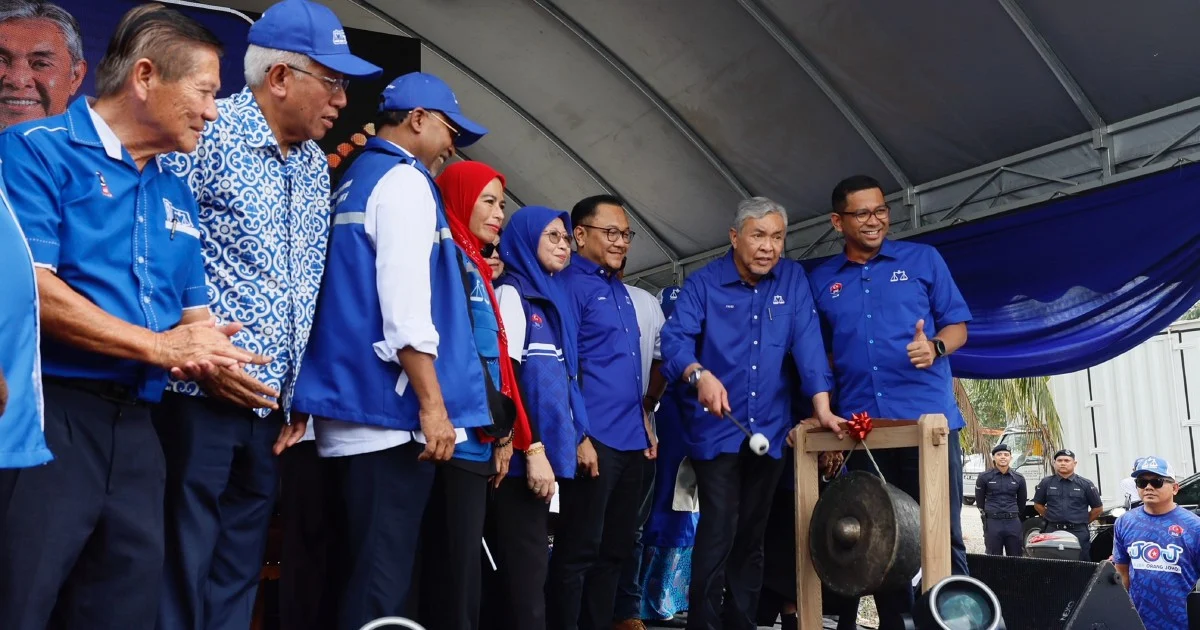
Deputy Prime Minister Datuk Seri Dr Ahmad Zahid Hamidi has issued a pointed challenge to PAS, demanding the Islamist party prove its professed backing for Barisan Nasional candidates through tangible electoral mobilisation rather than rhetorical endorsements. Speaking in Batu Pahat, Zahid underscored the importance of translating political commitments into on-the-ground voter support during the Johor election campaign, signalling potential tensions beneath the surface of the coalition partnership.
The remarks represent a significant moment in BN's pre-election positioning, highlighting underlying concerns about the reliability of PAS as an electoral ally. Zahid's public rebuke suggests that despite formal declarations of support, BN leadership remains uncertain whether PAS machinery will effectively channel voters toward coalition candidates or maintain a more neutral stance. This kind of direct appeal often signals internal coalition discussions about campaign execution and voter turnout strategies have not yet solidified.
Zahid's intervention in Johor holds particular significance given the state's political importance to BN's national ambitions. The southern state has traditionally served as a BN stronghold, though recent electoral cycles have demonstrated increasing competition from opposition coalitions. A strong showing in Johor would provide crucial momentum heading into any potential federal election and reinforce BN's narrative of renewed grassroots support after several years of internal restructuring.
PAS leadership has publicly committed to supporting BN candidates across multiple state elections as part of their ongoing cooperation framework. However, history suggests that formal coalition declarations do not automatically translate into equivalent levels of voter mobilisation at the community level. The party's grassroots structure operates with considerable autonomy in certain constituencies, particularly in areas with strong DAP or PKR presence where supporters may harbour competing loyalties.
The deputy prime minister's comments reflect broader coalition management challenges facing BN as it navigates partnerships with multiple political actors. Ensuring that each partner consistently directs its supporters toward coalition candidates requires sustained coordination, clear incentive structures, and demonstrated electoral benefits. Zahid's public call-out strategy appears designed to reinforce expectations and create accountability mechanisms that extend beyond ceremonial party-level agreements.
For Malaysian political observers, the Johor election serves as a testing ground for BN's revitalised coalition architecture. The ability to mobilise PAS voters effectively would validate BN's strategy of building broader partnerships across different political ideologies and constituencies. Conversely, weak PAS turnout for BN candidates would suggest the coalition remains fragmented and vulnerable to opposition advances in contested constituencies.
Southeast Asian context matters here as well. Malaysia's coalition politics exist within a regional environment where similar multi-party arrangements operate in neighbouring democracies. The strength of BN's coalition management directly affects perceptions of institutional stability and governance capacity both domestically and internationally. Investors and regional partners monitor these electoral processes as indicators of Malaysia's political health.
Zahid's emphasis on converting words into action also implicitly addresses grassroots party members who may need encouragement to actively campaign for coalition partners. PAS supporters in certain constituencies might hesitate to enthusiastically promote BN candidates if they perceive competing local interests. The deputy prime minister's message serves notice that coalition participation demands active engagement rather than passive acceptance.
The timing of Zahid's remarks ahead of the election campaign proper suggests BN strategists are already identifying potential vulnerabilities in their coalition arrangement. By addressing PAS performance expectations publicly, BN creates documentary evidence of its good-faith coordination efforts and establishes benchmarks against which subsequent electoral performance can be evaluated. This positions BN to claim credit for successful outcomes while deflecting responsibility for disappointing results onto coalition partners.
For PAS, the pressure placed by a senior BN figure highlights the delicate balance the party must maintain between demonstrating commitment to the coalition while preserving its distinct identity and organisational independence. The party faces competing expectations from its own supporters who joined for ideological reasons and from coalition partners seeking maximum electoral efficiency. Zahid's challenge essentially forces PAS to make public statements reaffirming its commitment, further binding the party into the coalition narrative.
The Johor election ultimately tests whether BN and its partners can operate as a genuinely unified electoral force or whether coalition structures remain primarily transactional arrangements of convenience. Zahid's comments suggest that behind-the-scenes coalition management has not yet achieved the seamless integration that successful broad-based coalitions require. The extent to which PAS responds to this challenge with concrete campaign infrastructure deployment will reveal much about the durability and effectiveness of BN's current partnership model.

