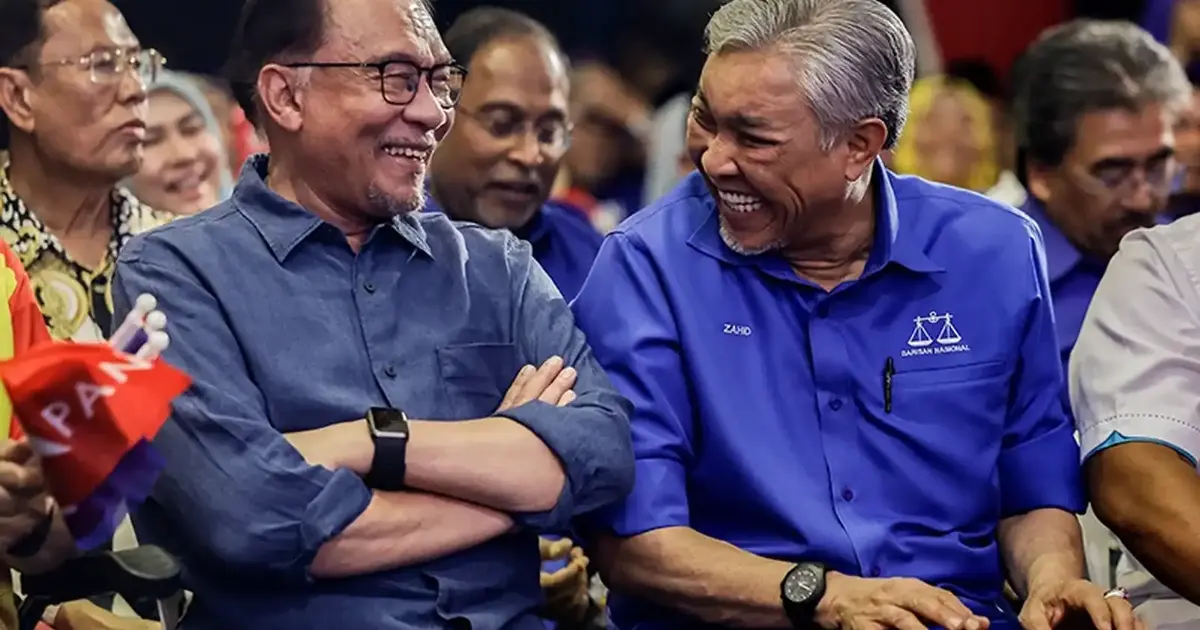
Deputy Prime Minister Ahmad Zahid Hamidi has chosen an unconventional diplomatic tool to address recent messaging from Prime Minister Anwar Ibrahim, crafting his own poem in response to the premier's earlier verse. The gesture underscores an ongoing conversation between the two leaders as they navigate their partnership within Malaysia's current political configuration, with Zahid simultaneously using the moment to underscore Barisan Nasional's unwavering commitment to the coalition government.
The exchange through poetry, whilst perhaps unusual in contemporary politics, reflects a cultural tradition of communication in Malaysia's political landscape. Such symbolic gestures often carry weight beyond their literary merit, serving as coded messages to party members, coalition partners, and the broader electorate about political intentions and alignments. Zahid's decision to respond in kind rather than through a conventional statement suggests an effort to match Anwar's tone whilst maintaining the dignity expected of high office.
Barisan Nasional's formal commitment to the unity government carries particular significance given the coalition's historical dominance in Malaysian politics. The party has undergone substantial transformation since losing federal power in 2018, and its decision to support the current administration represents a pragmatic recalibration of its political strategy. Zahid's reinforcement of this commitment during what appears to be a period of enhanced political messaging indicates BN leadership's recognition that stability in the coalition arrangement serves its electoral interests.
The timing of these poetic exchanges merit closer examination within the context of Malaysia's broader political dynamics. Coalition governments, by their very nature, require constant management and reinforcement of shared purpose. Public statements from senior figures, whether rendered in conventional prose or creative verse, function as reassurance mechanisms for coalition partners and signals to their respective party bases that partnerships remain solid despite underlying tensions.
Zahid's position as both Deputy Prime Minister and Barisan Nasional chairman places him at a critical juncture in Malaysian politics. He must simultaneously represent BN's interests within the government whilst maintaining his stature as a potential successor or alternative power center within his own party. His poetic response therefore serves multiple audiences: party loyalists who may harbour concerns about BN's subordinate role in the coalition, coalition partners seeking reassurance of BN's reliability, and the voting public assessing political stability ahead of future electoral contests.
The explicit emphasis on Barisan Nasional's continued commitment to serving the unity government through the end of the current term addresses speculation that periodically surfaces regarding coalition durability. Malaysian political history contains numerous examples of coalitions fracturing before their intended conclusion, and public reaffirmations become necessary to anchor expectations and prevent destabilising behaviour by coalition members sensing a weakening consensus.
This poetic exchange also reflects the personalised nature of Malaysian politics, where relationships between top leaders significantly influence institutional stability. The apparent cordiality suggested by Zahid's willingness to engage Anwar's message through similar creative means indicates a functioning working relationship, despite the obvious power imbalance inherent in their respective positions. Such signals matter considerably in a political system where factional divisions and personal rivalries can rapidly undermine formal institutional arrangements.
For regional observers and Malaysian business stakeholders, these communications carry practical implications. Political stability, even when maintained through carefully choreographed public messaging, remains preferable to the uncertainty that would follow coalition breakdown. The continuity suggested by Zahid's reaffirmation provides a degree of predictability for economic planning and investment decisions that depend on consistent governance.
The choice of verse as a medium also warrants consideration. Poetry permits greater ambiguity and layered meaning than direct political statements, offering both leaders flexibility in their messaging. What might appear as straightforward commitment to the unity government in conventional language can, through poetic expression, simultaneously communicate nuance to different audiences without explicit contradiction. This duality makes the form particularly suited to coalition politics, where competing interests require simultaneous reassurance.
Moving forward, the significance of this exchange will depend on how substantially the sentiments expressed through verse translate into concrete political action. Public reaffirmations of coalition loyalty prove meaningful only when accompanied by genuine operational cooperation between the coalition partners and their respective apparatuses. Zahid's emphasis on seeing the current government through to term suggests BN has calculated that maintaining the coalition arrangement through the scheduled end of the administration serves the party's strategic interests more effectively than alternative scenarios.
The broader context includes ongoing questions about Malaysia's political trajectory and the viability of multi-racial coalition governance in an era of increasingly polarised party politics. Barisan Nasional's participation in the unity government represents a significant departure from the competitive stance it adopted during the 2018 and 2022 general elections. Zahid's continued public support for this arrangement indicates BN leadership views this cooperation as preferable to returning to full opposition status or continuing electoral competition as a standalone entity.
As Malaysia approaches the medium term, these carefully calibrated messages between top leaders will continue shaping political calculations throughout the party system. The poetic exchange between Zahid and Anwar may ultimately be remembered as a minor episode in Malaysian political history, yet it encapsulates the delicate balance required to maintain coalition arrangements in a competitive democratic environment where multiple parties harbour distinct agendas and constituencies.

