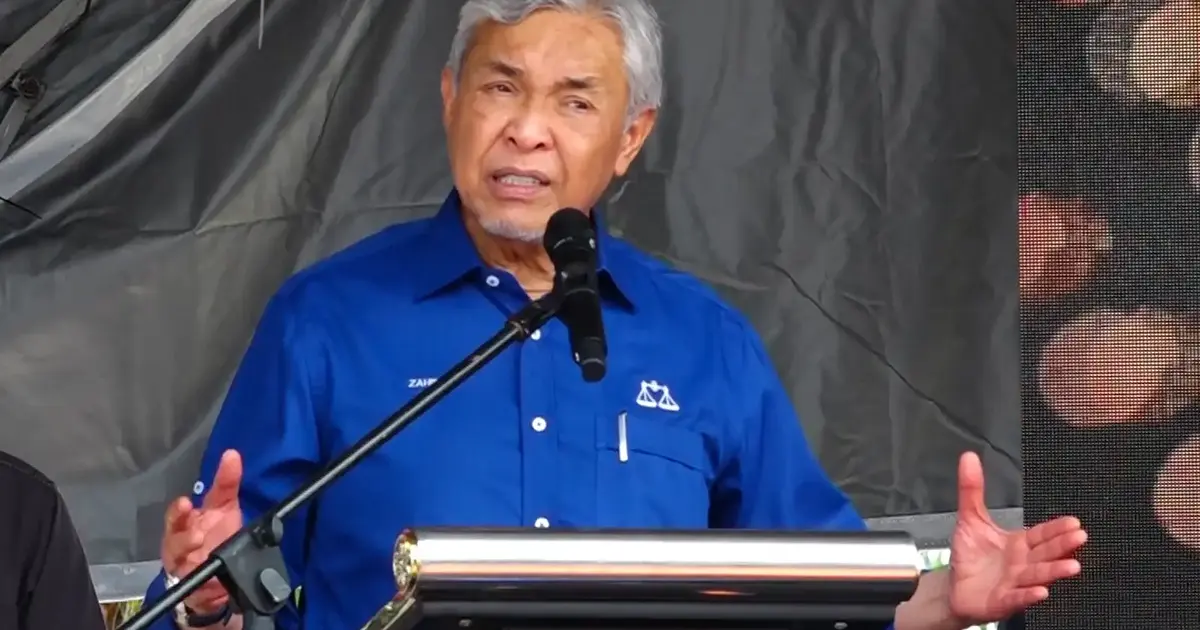
Ahmad Zahid Hamidi, the Barisan Nasional chairman, has categorically denied involvement in or awareness of any planned discussions between the four major political blocs, distancing his coalition from speculation about backroom negotiations that have circulated in recent political commentary. Zahid's statement arrives at a moment of considerable flux within Malaysia's coalition politics, where periodic rumours of realignment have become commonplace since the formation of the Madani administration under Prime Minister Anwar Ibrahim.
The denial carries particular weight given Zahid's role as both Umno president and BN chairman, positions that place him at the epicentre of peninsular Malay-Muslim political dynamics. By explicitly stating his unfamiliarity with any proposed gathering of BN, PN (Perikatan Nasional), GPS (Gabungan Parti Sarawak) and GRS (Gabungan Rakyat Sabah), Zahid attempts to quash interpretations that might suggest fractures within the government's parliamentary foundation or that BN leadership is entertaining alternative coalition architectures.
The timing of such denials often reflects underlying anxieties within governing coalitions about cohesion and electoral mathematics. Malaysia's political system, in which no single party commands overwhelming parliamentary dominance, creates persistent incentives for parties to explore repositioning ahead of GE16. These conversations occur across backchannels and at formal meetings, rendering definitive claims about what has or has not transpired inherently difficult to verify. Zahid's public repudiation serves partly as reassurance to fellow coalition partners and to party members who might otherwise interpret silence as tacit acknowledgment.
Crucially, Zahid reiterated that Barisan Nasional remains firmly committed to supporting the Madani government through to the sixteenth general election. This commitment represents the operational glue holding together the PH-BN-GPS coalition arrangement that has governed since late 2022. For BN, sustained participation in the Madani administration offers several strategic advantages: access to ministerial portfolios and federal resources, demonstration of governmental capacity, and opportunity to rebuild party fortunes after the 2022 electoral reversal that decimated Umno's parliamentary representation.
The mention of loyalty through GE16 carries temporal significance. Malaysia's electoral system permits considerable flexibility in the timing of general elections within a five-year constitutional window. The next election could feasibly occur anywhere between mid-2024 and late 2027, though recent political signals suggest 2025 or 2026 as more probable windows. Zahid's framing implies that BN views the partnership as sufficiently durable to warrant multi-year commitment rather than viewing coalition governance as a transient convenience pending the next electoral contest.
PN's position in this ecosystem remains more ambiguous. The coalition, led by Tan Sri Muhyiddin Yassin, sits in opposition while holding substantial parliamentary representation through its Malay-Muslim base and Sabah presence. PN has alternated between offering conditional support for specific government initiatives and registering trenchant opposition. Reports of PN-BN-GPS-GRS discussions might have reflected efforts to explore whether an alternative government could be constructed, a perpetual consideration in Malaysia's zero-sum parliamentary calculations where defections and coalition shifts can rapidly alter arithmetic.
GPS and GRS represent the eastern Malaysian constituencies whose parliamentary weight, though numerically modest, provides disproportionate leverage in coalition dynamics. Both parties jealously guard autonomy and resources, preferring to align with whichever configuration maximises extraction of state development funds and political concessions. Their inclusion in hypothetical coalition conversations typically signals attempts to reconstruct governing mathematics outside the current PH-BN-GPS arrangement.
For Malaysian observers, Zahid's dismissal underscores the fluid character of post-2022 politics. The government has demonstrated resilience despite periodic alarmism about its stability. However, the frequency of merger and realignment rumours reflects genuine underlying uncertainties about whether current parliamentary mathematics can sustain until a natural general election, or whether accelerated electoral cycles might force earlier reckonings. BN's public reaffirmation of commitment to Madani governance represents both genuine investment in the partnership and necessary theatre for political audiences requiring periodic assurance of stability.
The broader regional dimension also merits consideration. Malaysian coalition politics influences dynamics across Southeast Asia, where multiparty democracies struggle with coalition management. The Madani experiment in cross-party governance, despite its vulnerabilities, demonstrates possibilities for ideologically divergent parties to coexist within governmental frameworks—a model both instructive and cautionary for democracies throughout the region navigating complex post-election negotiations.
Zahid's statement, while seemingly dismissive of one set of rumours, implicitly validates the entire genre of coalition speculation that characterises contemporary Malaysian politics. Periodic denials have become ritualistic elements within the political calendar, necessary performances in which senior figures reassure constituents, coalition partners, and international observers that arrangements, however fragile, remain intact. The Madani government's continuation through such cycles, despite numerous predictions of imminent collapse, suggests either greater stability than critics acknowledge or simply that the electoral alternative remains sufficiently unappealing to parties currently in power.

