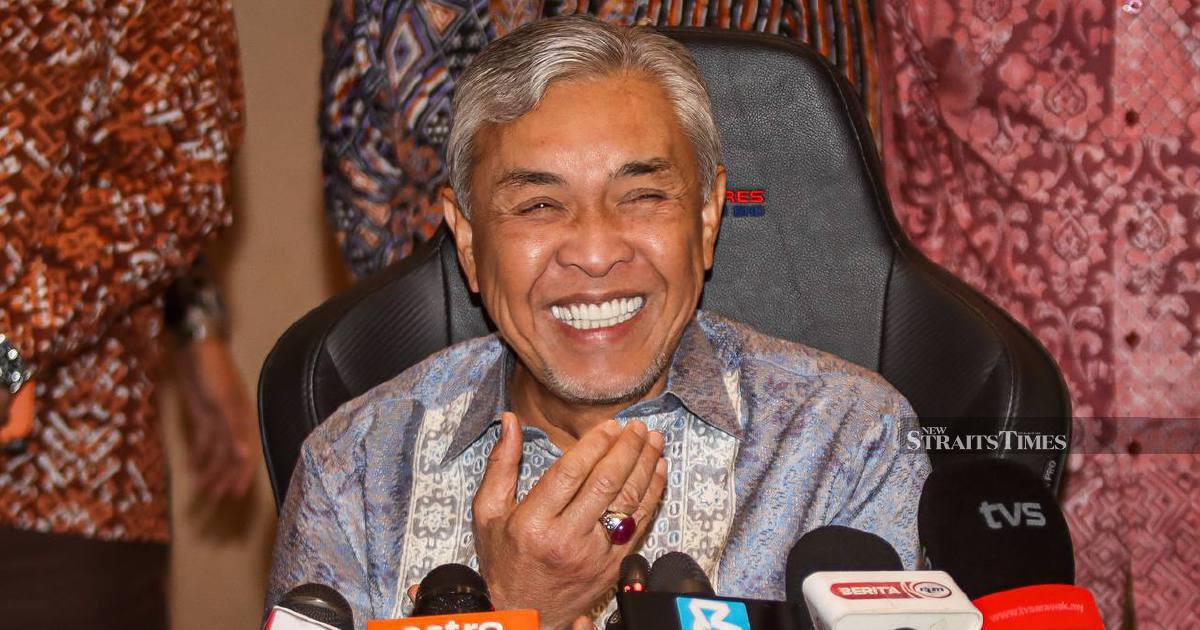
Deputy Prime Minister Datuk Seri Dr Ahmad Zahid Hamidi has crafted a four-line pantun as a poetic response to Prime Minister Datuk Seri Anwar Ibrahim's earlier unity-themed verse, demonstrating how Malaysia's top leadership continues to communicate through traditional literary forms. The exchange, which unfolded in George Town, highlights an intriguing dimension of political discourse in the country where classical Malay poetry serves as a medium for expressing broader national sentiments.
The pantun tradition, deeply rooted in Malay culture and spanning centuries, has long served as more than mere entertainment or artistic expression. These quatrains have historically been employed by communities to convey messages of significance, whether moral, social, or political. The fact that Malaysia's highest-ranking officials are engaging in this form of communication underscores the cultural resonance such verses maintain within the nation's political sphere, even as the country navigates modern governance challenges.
Anwar Ibrahim's initial contribution to this poetic dialogue had centered on themes of unity, reflecting ongoing efforts by the Prime Minister's administration to emphasise cohesion across Malaysia's diverse political and ethnic landscape. The symbolic language embedded in such verses often carries layered meanings that extend beyond surface-level interpretation, allowing for nuanced expression of complex ideas that might otherwise require lengthy policy statements or formal speeches. By framing his message through pantun, Anwar tapped into a format that resonates across generations and communities.
Zahid's response, characterised as addressing a motif of shelter and turbulence, suggests he is engaging substantively with Anwar's themes rather than offering a dismissive retort. The metaphor of a roof and storm carries obvious implications about protection, stability, and weathering challenges—concepts highly relevant to a coalition government managing internal tensions while facing external pressures. The imagery allows both leaders to communicate about governance and national resilience without resorting to confrontational language.
This exchange occurs within a broader context of Malaysia's coalition politics, where the relationship between the Prime Minister and Deputy Prime Minister carries considerable weight. Both Anwar Ibrahim and Ahmad Zahid Hamidi represent significant political constituencies and bring distinct experiences to their respective offices. Their ability to engage constructively, even symbolically through traditional verse, sends signals about the functionality of the current administration's internal dynamics.
For Malaysian citizens and regional observers, such interactions serve as a barometer of political stability. When senior leaders communicate through established cultural traditions rather than through acrimony or public disputes, it often suggests a baseline level of institutional health. The pantun exchange, far from being merely ceremonial, becomes a form of political messaging that carries weight within Malaysian society where cultural symbols retain importance in public discourse.
The choice to respond in kind—with verse answering verse—also demonstrates respect for established protocols and cultural norms. This reciprocal engagement suggests an understanding that certain forms of communication carry more gravitas within the Malaysian context than others. Where Western political traditions might favour press conferences or official statements, Malaysia's leadership recognises the potency of expressions grounded in the nation's own heritage and values.
From a Southeast Asian perspective, this episode illustrates how traditional cultural forms continue to shape contemporary political communication across the region. Malaysia is far from alone in maintaining such practices; other nations similarly leverage indigenous artistic traditions to express political messages. This underscores a broader reality: that modernisation and cultural continuity need not be opposing forces, and that political leadership can draw on both contemporary mechanisms and ancestral practices simultaneously.
The substantive content embedded within Zahid's pantun response will likely become the subject of interpretation among political observers and cultural commentators. The specific imagery chosen—whether metaphorical references to structural stability, institutional frameworks, or the capacity to endure difficulties—carries implications for how the government wishes to project its own narrative. Such layered communication allows both explicit and implicit messages to coexist within the same expression.
For the broader Malaysian polity, this exchange between Anwar and Zahid represents more than a cultural curiosity or nostalgic indulgence. It reflects how leadership in Malaysia remains anchored to the nation's Islamic and Malay cultural foundations, even as the country operates as a modern, multi-ethnic democracy navigating globalised challenges. The pantun, in this context, becomes a vehicle for demonstrating cultural literacy and connection to historical continuity.
The implications of this poetic dialogue extend to how Malaysia positions itself internationally as well. A government whose top officials can engage meaningfully with traditional cultural forms projects an image of confidence in its own identity and heritage. This contrasts with political systems where such engagement might be dismissed as backward-looking; here, it is treated as a legitimate and valued form of elite communication.
As Malaysia continues to address domestic challenges ranging from economic restructuring to social cohesion, such moments of cultural engagement serve important symbolic functions. They remind citizens that governance, while increasingly technical and complex, remains grounded in the nation's enduring values and traditions. The pantun exchange between Anwar and Zahid, therefore, communicates beyond the immediate political moment, speaking to questions of identity, continuity, and Malaysia's place within its own historical narrative.

