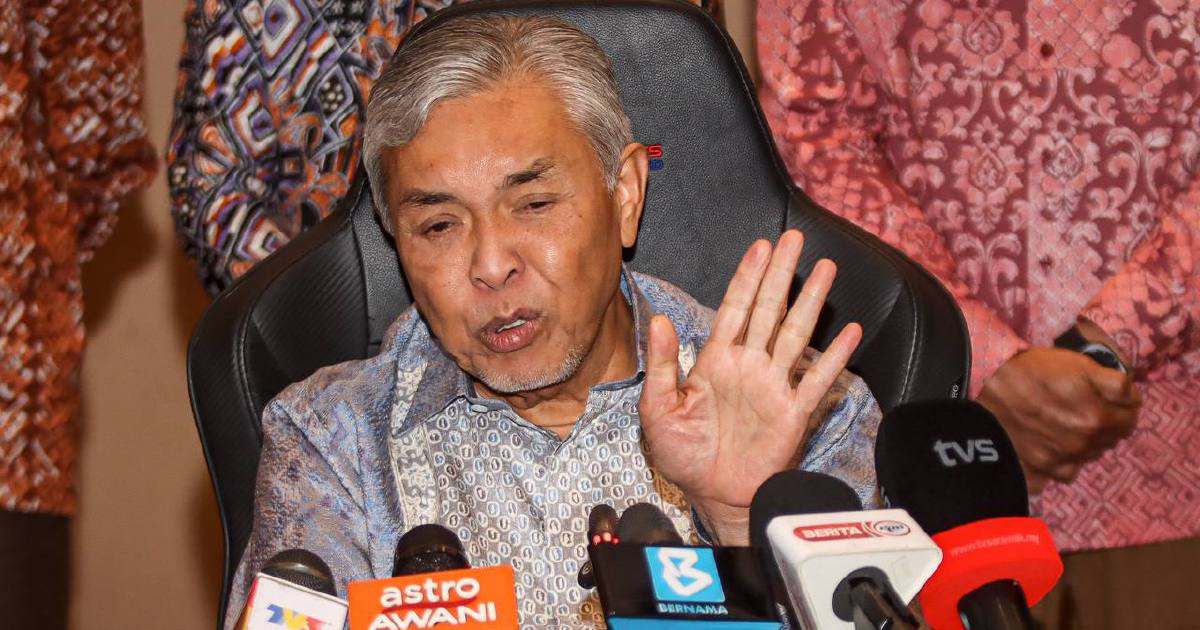
Datuk Seri Dr Ahmad Zahid Hamidi has categorically rejected mounting speculation that Barisan Nasional harbours intentions to remove Prime Minister Datuk Seri Anwar Ibrahim from office, declaring instead that the coalition remains steadfastly committed to sustaining the unity government framework until Parliament's 15th term concludes. The statement, made during a visit to George Town, comes amid persistent rumours in political circles questioning the stability of Malaysia's current governing arrangement and the durability of cooperation between the major coalitions.
The dismissal by the Barisan Nasional chairman carries particular significance given the coalition's pivotal role in anchoring the unity government formed following the 2022 general election. As the largest bloc within the governing partnership, Barisan Nasional's position fundamentally shapes the trajectory of the Anwar administration. Any fragmentation or withdrawal of support from the coalition could theoretically destabilise the government, making Zahid's unequivocal reaffirmation of commitment strategically important for reassuring investors, foreign observers, and Malaysia's diverse stakeholder communities about political continuity.
The timing of Zahid's remarks reflects an ongoing pattern of political noise that periodically surfaces whenever the unity government faces challenges or when component parties manoeuvre for advantage within the coalition structure. Such speculation often stems from competing interests among the different components—UMNO, MCA, MIC, and various smaller parties within Barisan Nasional—alongside their coalition partners in Pakatan Harapan and other supporting entities. Understanding these internal dynamics provides crucial context for interpreting what might otherwise appear to be mere routine political commentary.
The 15th Parliament, to which Zahid references, was seated following the November 2022 general election and is scheduled to run its full term, barring extraordinary circumstances such as a dissolution of Parliament. This natural lifecycle means the next general election would typically occur before late 2027, giving current political arrangements a defined timeline. Zahid's pledge to maintain unity government support until this juncture effectively commits Barisan Nasional to working within the existing framework for approximately four-and-a-half years from the coalition's formation, a substantial commitment in Malaysian politics where coalitions have historically proved fragile.
For Malaysian readers and regional observers, Zahid's statement carries broader implications for governance stability and policy continuity. A unity government represents a deliberate sacrifice of adversarial politics in favour of consensus-building, a structure designed to prevent the polarisation that characterised earlier periods. This arrangement, while sometimes frustrating for those seeking decisive single-party governance, has enabled Malaysia to navigate post-election tensions and focus on economic recovery and institutional rebuilding.
The unity government model also presents practical advantages for business confidence and international relations. Foreign investors and trading partners historically prefer political certainty; assurances of government stability, particularly from senior coalition figures, help sustain economic momentum and attract capital flows. Southeast Asia has witnessed instances where political volatility derailed development programmes, making Zahid's categorical pledge relevant to stakeholders far beyond Putrajaya.
Barisan Nasional's commitment extends beyond mere passive acquiescence; it involves active participation in governance through ministerial positions, parliamentary support for legislation, and collaborative policy formulation. UMNO, through its dominance within Barisan Nasional, effectively shapes the coalition's direction. Zahid's remarks therefore represent not merely his personal position but the distilled will of UMNO's leadership, the party that commands the overwhelming majority of Barisan Nasional seats in Parliament.
The broader political landscape in Malaysia has evolved considerably since the 2022 election. The unity government emerged partly as a pragmatic response to electoral fragmentation, with no single coalition commanding an absolute majority. Over subsequent months, various parties have tested the boundaries of this arrangement, occasionally threatening to withdraw or demanding concessions. Zahid's latest statement serves as a reset button, clarifying intentions and attempting to silence disruptive speculation that might undermine coordinated governance.
For Anwar's administration, such statements from coalition partners carry material weight. While the Prime Minister commands parliamentary support through multiple mechanisms, explicit reaffirmation from Barisan Nasional leadership removes ambiguity about whether the government faces internal threats. This clarity allows the cabinet to focus on substantive policy implementation—addressing inflation, unemployment, infrastructure development, and educational reform—rather than consuming energy on survival politics.
The regional dimension merits consideration as well. Malaysia's political stability influences the broader stability calculus for ASEAN and Southeast Asia. A cohesive, functioning Malaysian government contributes to regional confidence in democratic institutions operating in a diverse, multi-confessional context. Conversely, political instability can have spillover effects, complicating ASEAN consensus-building on regional security and economic matters. Zahid's commitment to unity government continuity therefore carries implications extending beyond Malaysia's borders.
Looking ahead, maintaining unity government cohesion will require ongoing negotiation and compromise. Different coalition components inevitably have divergent policy priorities and electoral calculations. The success of this arrangement ultimately depends on leadership's willingness to subordinate narrow partisan interests to the broader collective good—a delicate balance requiring constant reinforcement through public statements such as Zahid's declaration and through sustained institutional mechanisms ensuring regular inter-coalition consultation and dispute resolution.

