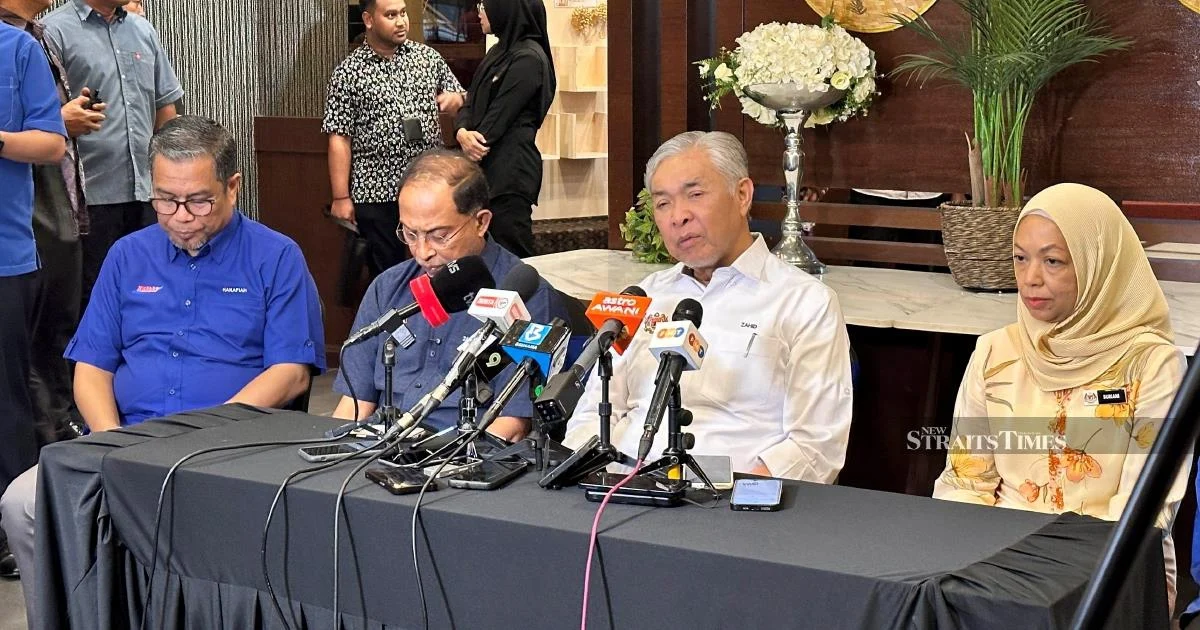
Barisan Nasional chairman Datuk Seri Dr Ahmad Zahid Hamidi signalled his displeasure with a unity government coalition member's decision to leverage imagery associated with the Najib-Rosmah era during the Johor state election campaign. Speaking at an event in Kluang, Zahid appeared to rebuke the use of Datin Seri Rosmah Mansor's photograph in campaign materials, implicitly cautioning against invoking figures and controversies from Malaysia's previous administration as the unity coalition works to retain support in the state.
The rebuke underscores ongoing tensions within the Pakatan Harapan-Barisan Nasional alliance regarding which personalities and historical narratives should dominate campaign messaging. While the unity government has governed together since the 2022 general elections, the coalition remains fragmented across competing political narratives and legacies. The question of how prominently to feature or reference the previous administration—particularly individuals closely associated with the 1Malaysia Development Berhad (1MDB) scandal and related controversies—continues to generate friction among partner parties.
Johor represents strategically crucial territory for both BN and the broader unity coalition. As Malaysia's second-largest state by population and a traditional BN stronghold, electoral performance here carries outsized weight in determining overall coalition cohesion and public perception. The state has historically been the bedrock of Umno dominance, making campaign strategy particularly sensitive to internal party dynamics and broader questions about how the coalition should position itself ideologically and morally.
Zahid's intervention reflects growing concern among BN leadership that certain party components or affiliated groups may be undermining the coalition's efforts to present a unified, forward-looking agenda. The inclusion of figures associated with the previous Najib administration risks reopening divisions over governance failures, corruption allegations, and economic mismanagement that the current administration would prefer to move beyond. From a strategic perspective, continuously referencing these controversies may alienate swing voters who have moved on and wish to focus on present-day governance rather than historical grievances.
The timing of this guidance is significant as Johor prepares for what is expected to be a closely contested state election. Campaign messaging becomes increasingly important when electoral margins are projected to be narrow. By instructing coalition partners to refrain from deploying divisive historical imagery, Zahid appears to be attempting to enforce message discipline and prevent fragmentation that could weaken the unity government's collective campaign performance.
For observers in Malaysia and across Southeast Asia, this episode illuminates the continuing challenges facing multi-party coalitions built on pragmatic rather than ideological grounds. The unity government was formed to prevent Umno and PAS from dominating parliament, but it has repeatedly struggled to maintain cohesive narratives when constituent parties hold fundamentally different views about recent history and responsibility for past governance failures. What constitutes acceptable campaign material remains a live point of contention.
Zahid's remarks also indicate hierarchical dynamics within BN itself. As chairman, his rebuke suggests he retains significant authority to set tone and enforce discipline, yet the very need to issue such guidance implies that some partner parties or faction leaders are testing boundaries or pursuing parallel messaging strategies. This dynamic mirrors broader challenges seen across Southeast Asian coalitions, where maintaining unity while accommodating diverse party interests proves perpetually difficult.
The Rosmah controversy specifically touches on Malaysia's deepest recent political wounds. Her husband, Najib Razak, faces multiple convictions related to financial mismanagement and remains a polarising figure. While some voters view him as a victim of political persecution, others see him as emblematic of an era of unchecked elite excess and institutional decay. References to this period carry inherent divisive potential, explaining why Zahid would seek to prevent such deployment in formal coalition messaging.
Moving forward, the BN and broader unity coalition face the challenge of establishing what historical references, if any, are appropriate in campaign contexts. Complete erasure of recent history is unrealistic and potentially counterproductive, yet unbridled nostalgia for the previous era alienates reform-minded voters. Zahid's intervention suggests the coalition leadership recognises this balance but continues to work through how precisely to operationalise it across diverse party structures.
For Malaysian voters observing these manoeuvres, the episode raises questions about campaign authenticity and whether parties within the unity government genuinely share coherent values or merely occupy the same political space out of necessity. The ability to present unified messaging without requiring explicit rebuke of coalition partners would signal stronger institutional alignment. The current situation instead reveals the fragility of Malaysia's coalition arrangements and the persistent challenge of forging consensus on even basic matters of campaign presentation.
The Johor campaign will likely test these tensions further as the election draws closer. How effectively the BN and its coalition partners implement Zahid's guidance may determine not only electoral outcomes in the state but also the durability of the unity government arrangement more broadly.

