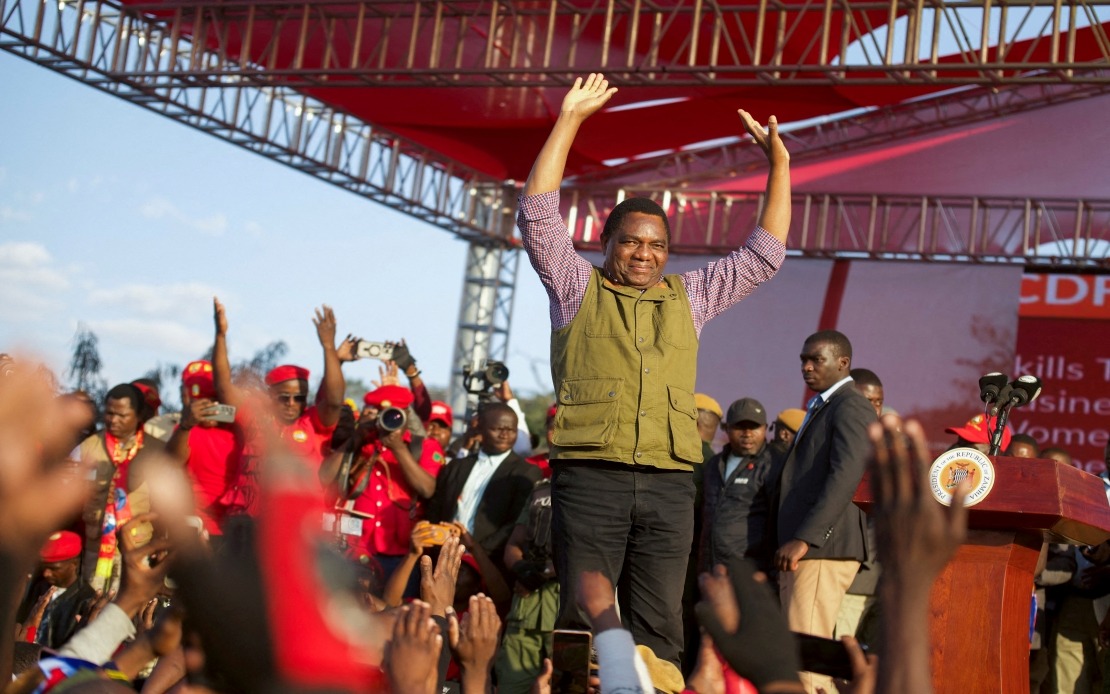
Zambian President Hakainde Hichilema has emerged with a decisive advantage in the nation's presidential election, accumulating more than 1.5 million votes as counting progressed through Sunday across 135 of the country's 226 constituencies. The 64-year-old incumbent, running on the platform of the ruling United Party for National Development (UPND), has garnered 1,544,140 votes, substantially outpacing his rivals in what is shaping as a commanding performance. Electoral Commission of Zambia Chairperson Mwangala Zaloumis announced the consolidated figures at the National Election Results Centre in Lusaka, signalling momentum that could carry Hichilema to another five-year term.
Hichilema's performance reflects his appeal across key demographic segments, built largely on his track record during his inaugural administration that commenced in 2021. The economist and rancher defeated the then-incumbent Edgar Lungu with a margin exceeding one million votes, establishing a strong foundation for his current bid. His administration has prioritized economic restructuring, particularly addressing Zambia's substantial debt burden that had constrained public spending and investor confidence. The government has concurrently worked to revitalize the mining sector, a cornerstone of the Zambian economy that had suffered from commodity price volatility and operational challenges in preceding years.
During his first term, Hichilema introduced a free education initiative encompassing public primary and secondary schools, a populist measure that resonated with voters in a nation where educational access remained a challenge for lower-income families. This social investment, coupled with the government's visible efforts to stabilize the macroeconomic environment, has created tangible outcomes that communities across the country can reference. For many Zambians, these achievements represent concrete improvements in living standards and future opportunity, distinguishing Hichilema from opposition alternatives.
His principal competitor, Brian Mundubile, represents the National Reconciliation Party for Unity and Prosperity (NRPUP) and has captured 1,030,662 votes from the same 135 constituencies—a substantial showing that reflects genuine opposition support but a gap of over 500,000 votes that would require a dramatic shift in remaining results. Mundubile, 55 and trained as a lawyer, has positioned his coalition to consolidate gains in Zambia's urbanized zones, particularly stretching through Lusaka and the Copperbelt region where population density and industrial activity concentrate dissent from incumbent policies. His campaign has attempted to mobilize urban voters who may perceive economic benefits as unevenly distributed or who harbor concerns about governance continuity.
Zambia's constitutional framework establishes that a presidential candidate must achieve more than 50 per cent of valid votes cast to claim victory outright. This threshold requirement shapes campaign strategy and coalition-building, as candidates recognize that falling short necessitates entry into a second-round ballot contested between the top two contenders. The 50-per-cent requirement prevents plurality victories and ensures the elected president commands majority support, a safeguard that has been tested in previous Zambian elections and reflects the country's commitment to democratic legitimacy.
Given Hichilema's substantial lead at this counting stage, the mathematical pathway to crossing the 50-per-cent threshold appears increasingly probable, though final results from the remaining 91 constituencies will ultimately determine the outcome. Should he secure victory, it would represent validation of his economic program and social initiatives by the electorate, lending legitimacy to decisions on debt servicing, mining sector policy, and educational spending that have occasionally generated internal debate. For the Southern African region, a Hichilema victory would provide continuity in Zambian economic policy and maintain alignment with international financial institutions on macroeconomic management.
The election unfolds within a broader context of economic challenge across much of Southern Africa, where debt levels, currency pressures, and commodity dependence create complex governance environments. Zambia, as the world's second-largest copper producer after Chile, occupies a particular position within this landscape, and presidential leadership over mining policy and revenue distribution carries implications beyond national borders. Regional investors, regional governments, and international creditors have stakes in political outcomes that shape Zambian economic trajectory and foreign policy orientation.
Mundubile's performance, while trailing significantly, demonstrates that organized opposition remains capable of mobilizing voters and winning constituencies, suggesting that Zambian democracy sustains genuine competition rather than one-sided dominance. The opposition's particular strength in urban corridors reflects grievances that merit acknowledgment and addressing, regardless of election outcomes. This geographic polarization between urban opposition strength and rural or provincial UPND support has characterized Zambian politics and may influence subsequent policymaking and coalition dynamics in parliament.
The presence of 12 candidates competing for the presidency reflects fragmentation within opposition ranks and the proliferation of smaller parties, each attempting to carve electoral niches. This multiplication of candidates ultimately advantages the frontrunner by dividing anti-incumbent sentiment, a dynamic that research on African elections has repeatedly documented. For Malaysia and other regional observers, the Zambian election process offers comparative lessons regarding constitutional frameworks, electoral administration, and the consolidation of incumbent advantage through demonstrated economic performance and social provision.
As final constituency results arrive and the counting process concludes, the Electoral Commission of Zambia will announce the definitive winner, triggering either Hichilema's inauguration for a second term or a runoff ballot requiring campaigns to intensify their mobilization. The trajectory visible in Sunday's results strongly suggests the former scenario, preparing Zambian institutions for continuity in leadership and economic policy direction through 2026. For Hichilema personally, a decisive victory would validate his economic program and provide a renewed mandate to accelerate the structural reforms that his first term initiated but which require multi-year implementation to generate widespread benefits.

