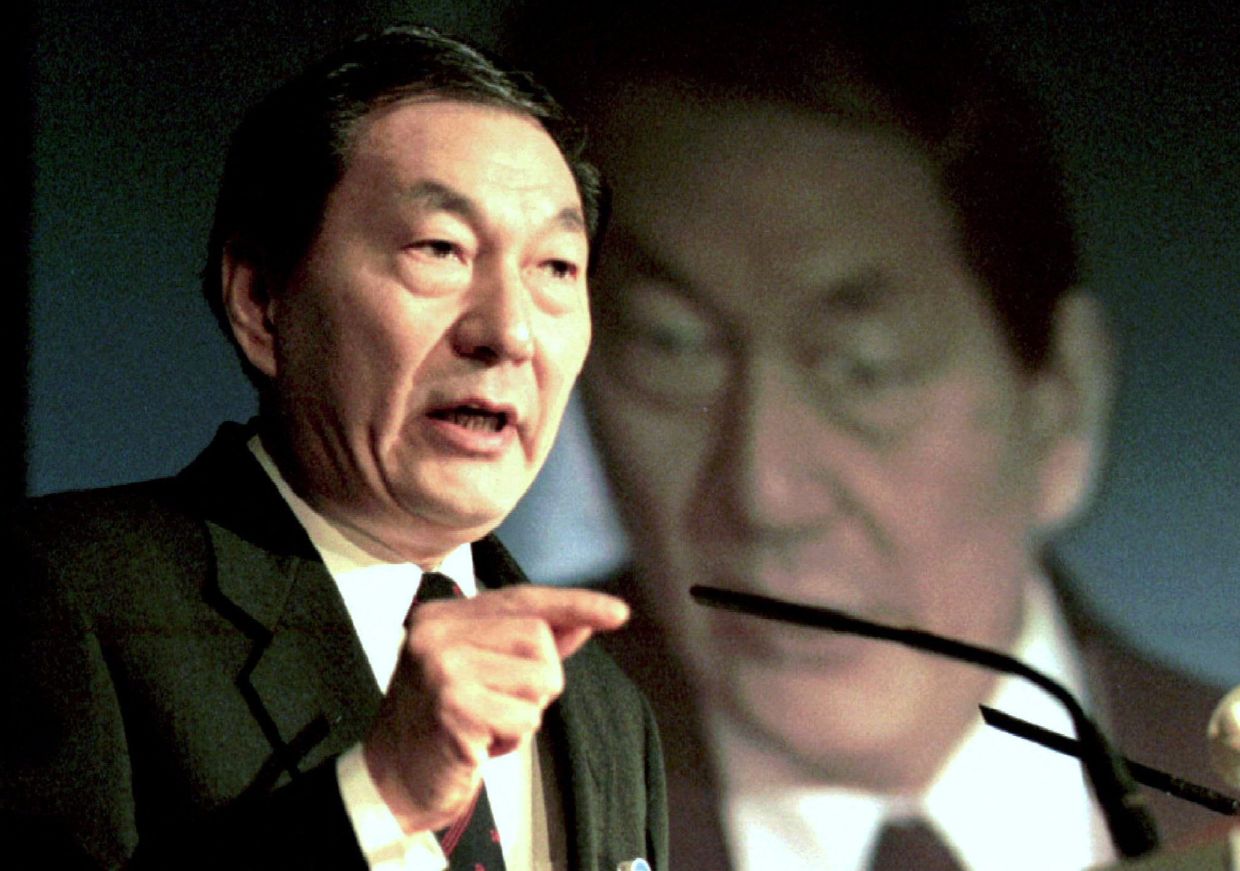
Zhu Rongji, the visionary premier who transformed China's command economy into a market-oriented system and shepherded the nation into the World Trade Organization, passed away in Beijing on Wednesday, 12 August after receiving medical treatment for an undisclosed illness. He was 98. The architect of some of the most consequential economic policies of the late 20th century, Zhu fundamentally reshaped the trajectory of the world's most populous nation during his tenure as premier from 1998 to 2003, leaving an indelible mark on global trade relations and China's economic ascendancy.
Zhu's tenure as China's chief economic planner and subsequently as premier came during a particularly turbulent period for the country's development. He navigated the nation through the convulsions of the 1997 Asian financial crisis and battled entrenched double-digit inflation while simultaneously pursuing sweeping structural reforms. His approach stood in stark contrast to the more cautious incrementalism that had characterised much of the reform era, and his willingness to absorb significant social costs in pursuit of long-term economic modernisation would define his legacy. The scale of disruption was unprecedented: tens of millions of workers lost their employment as Zhu systematically dismantled inefficient state enterprises across telecommunications, banking, petroleum and manufacturing sectors, closing down tens of thousands of organisations that had accumulated unsustainable debt and showed no prospect of profitability.
Perhaps Zhu's most enduring achievement was facilitating China's accession to the World Trade Organization in 2001, a decision that would reshape global supply chains and establish Beijing as a manufacturing powerhouse. In 2000, he met with then-European Union Trade Commissioner Pascal Lamy in Beijing to resolve critical impasses in the negotiation process, clearing the path for China's integration into the rules-based international trading system. The economic consequences have been staggering: China's gross domestic product has expanded more than eleven-fold since that watershed moment, propelling the nation to its current status as the world's second-largest economy. Yet this integration has not proceeded without friction, as trading partners have repeatedly accused Beijing of circumventing WTO obligations through state subsidies, import barriers, and intellectual property violations—tensions that remain contentious two decades later.
Zhu's stewardship of financial sector reform proved equally transformative. As governor of the People's Bank of China from 1993 to 1995, he initiated pilot programmes to welcome foreign financial institutions and orchestrated China's first international bond issuance, opening channels that would eventually attract unprecedented capital inflows. More dramatically, in 1999 he oversaw the creation of asset-management companies tasked with absorbing 1.4 trillion yuan (approximately US$220 billion) in non-performing loans that had festered within the Big Four state-owned banks. This controversial move, which effectively socialised enormous losses, was politically and economically necessary: it allowed the major banks to rehabilitate their balance sheets and subsequently go public beginning in 2005, establishing them as globally competitive institutions operating on market principles rather than policy directives.
The contrast between Zhu's market-oriented philosophy and the priorities of his successors illuminates a fundamental tension within contemporary Chinese governance. Successive administrations, particularly under President Xi Jinping, have reversed course and advocated for a "stronger, better, and bigger" state-controlled economy designed to advance perceived national strategic interests. This ideological divergence reflects broader debates about whether market mechanisms or state direction should be the primary mechanism for resource allocation—a question that remains unresolved within the Chinese Communist Party's hierarchy. Where Zhu saw inefficiency and insisted on competitive discipline even at tremendous social cost, Xi's administration has emphasised the strategic imperative of state control over key sectors and champions of state enterprise reform have found themselves marginalised.
Zhu's personality and operational style earned him distinction even among China's senior leadership. John Thornton, the former co-president of Goldman Sachs who managed the October 1997 Hong Kong initial public offering of what became China Mobile Ltd., recalled that Zhu displayed an exceptional mastery of technical and financial detail. During a meeting convened on Hainan Island where Goldman Sachs executives and Deutsche Telekom experts were assembled to advise China Mobile on establishing modern corporate functions, Zhu peppered the executives with penetrating questions that reflected his comprehensive understanding of telecom sector economics. "We'd answered these questions many times before, but usually you don't get these questions from the premier of a country," Thornton observed, noting that such granular queries typically emerged from corporate financial officers rather than heads of government. This combination of strategic vision and tactical attentiveness became his hallmark.
Beyond economic restructuring, Zhu initiated an aggressive anti-corruption campaign and pursued administrative rationalisation that earned him the nickname "one-chop Zhu"—a reference to the official chops or seals required to authorise documents in the Chinese bureaucratic system. His determination to eliminate unnecessary approval procedures and cut through red tape represented a radical departure from the procedural sclerosis that had accumulated across government agencies. He impressed international audiences with his command of English and evident sense of humour. During a 1999 joint press conference with United States President Bill Clinton in Washington, when confronted with allegations that China had made political contributions to the Democratic Party, Zhu responded with deflating wit: "This shows that some Americans really have underestimated us. If political contributions could really be effective, and I have $146 billion of foreign-exchange reserves, I could take out at least $10 billion for this purpose. Why just $300,000? That would be too foolish!" The remark drew appreciative laughter and underscored how unconventional his public presentation was for a senior Chinese leader.
Zhu's formative experiences shaped his pragmatic and results-oriented approach to governance. Born in October 1928 in Hunan province, he attended Tsinghua University from 1947 to 1951, majoring in electrical engineering before joining the Communist Party in the month of the People's Republic's founding. During the Hundred Flowers Campaign, when Mao Zedong temporarily permitted candid criticism, Zhu voiced scepticism about the Chairman's economic policies, arguing they produced irrational growth patterns. This candour proved costly: he was branded a "rightist" and demoted. During the Cultural Revolution he spent five years in rural exile, engaged in subsistence farming—raising pigs and planting rice—an experience that exposed him directly to agricultural realities and popular suffering. After his rehabilitation in 1978, he ascended through municipal and provincial administration, serving as Shanghai's mayor from 1987 before being elevated to vice premier in 1991 and winning appointment to the Politburo Standing Committee in 1992.
Following his relinquishment of the premiership to Wen Jiabao in 2003, Zhu devoted himself to elevating the international reputation of Tsinghua University, his alma mater, and channelled book royalties into donations supporting rural educational institutions. He expressed his personal hopes for his legacy with characteristic modesty, stating during a 2000 national legislature session: "I only hope that after I leave office, the Chinese people will say that he was a clean official, not a corrupt one. I would be very satisfied. If they are more generous and say that Zhu Rongji got some real things done, then I'd thank heaven and Earth." This sentiment captured the tension between his utilitarian focus on accomplishment and his awareness of the human costs entailed by his policies. Zhu is survived by his wife, Lao An, and two children: his son Levin Zhu, who headed China International Capital Corp during the early 2000s through 2014, and his daughter Zhu Yanlai, who occupied senior management positions at Bank of China (Hong Kong).

