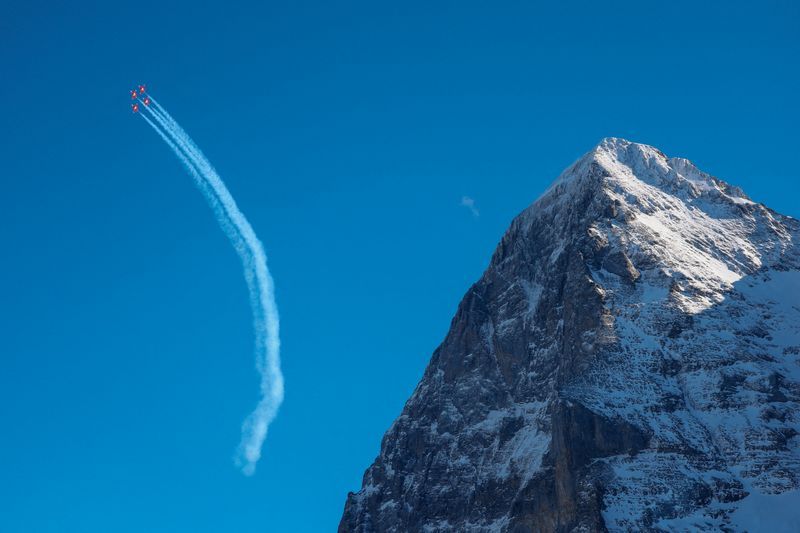
British mountaineer Fay Manners has etched her name into Alpine climbing history by establishing the first new route on the Eiger North Face to be opened by a British woman. Working alongside Swiss climber Roger Schaeli over 13 days this summer, Manners pioneered "Solar Eclipse," a challenging 2,952-foot ascent comprising 33 pitches through previously unclimbed terrain on one of Europe's most formidable natural obstacles.
The Eiger North Face, rising 5,900 feet from the Swiss Alps, has commanded respect and fear in equal measure since mountaineers first began attempting its vertical expanse of rock and ice. The wall's exposure to unpredictable weather patterns and rockfall hazards claimed numerous lives before a German-Austrian expedition finally succeeded in 1938, establishing the route now known as the Heckmair Route. Today, the North Face remains a testing ground for elite alpinists seeking to push the boundaries of their sport, yet its guidebooks overwhelmingly reflect the achievements of male pioneers.
Manners' route-opening accomplishment carries significance that extends well beyond the technical achievement of reaching the summit. Four years prior, the 39-year-old had climbed the established Heckmair Route, an experience that sparked an obsessive engagement with the mountain's structure and possibilities. That reconnaissance and reflection process ultimately convinced her to return not as a visitor following someone else's path, but as a creator charting her own line through unconquered rock.
The distinction between repeating an established route and pioneering a new one lies at the heart of mountaineering's creative frontier. Climbers attempting known routes benefit from documented difficulty ratings, established protection points, and the certainty that others have summited before them. Route-opening presents an entirely different proposition: climbers face genuine uncertainty about what lies ahead, which equipment will secure their passage, and whether the line they envision will ultimately prove feasible. "You don't know how hard it's going to be, you don't know the sort of protection that you'll need to put in, you really don't know if you're going to be able to make it to the top," Manners explained in reflecting on the undertaking.
For Manners, the creative act of establishing new routes carries particular importance within mountaineering's gender dynamics. The sport's historical narratives, preserved in guidebooks and climbing literature, predominantly feature male names alongside pioneering achievements. This pattern, she argues, silently communicates a powerful message to aspiring female climbers about whose accomplishments the sport recognises and whose contributions matter. "If you're looking in the guidebook and every single name of the person that's opened a route is male, somehow that's telling you that men are opening routes and women aren't," she observed. The presence of women's names among route-openers therefore becomes more than a statistical detail—it represents a tangible shift in how the sport documents and celebrates achievement.
Women have participated in the Eiger's climbing history for longer than many realise, though often against institutional resistance. In 1964, British climber Daisy Voog became the first woman to successfully ascend the North Face, having previously attempted to join an elite mountaineering club that rejected her membership solely on the basis of gender. Five years later, Japanese alpinist Michiko Imai became the only female member of a six-person expedition that established the "Japanese Summer Direttissima" route. These pioneering efforts, while significant, have remained outliers in a sport whose historical record privileges male contributions.
Manners traces the roots of gender underrepresentation in mountaineering to subtle cultural messaging that shapes aspirations from childhood. She questions how systemic assumptions about physical capability and career viability limit what women internalise as possible for themselves. "Maybe if I never grew up with someone saying to me, 'You can't carry as much as me, so I'll carry more,' maybe if it was just always equal from the beginning, then you just never have that doubt in your mind," she reflected. These doubts, she argues, operate beneath conscious awareness, embedded so deeply in social expectations that people rarely notice their influence.
Manners' own journey to professional mountaineering illustrates this dynamic. Growing up in England, she possessed genuine athletic talent and contemplated pursuing sport as a career. However, people around her consistently suggested that women faced insurmountable barriers to earning a sustainable living through athletic pursuits. Accordingly, she pursued a more conventional path, studying data science and later working as a consultant while living in Chamonix, France. It was only when sponsorship opportunities materialised that she recognised professional climbing could genuinely become her vocation. "I really only realised that it was possible when it was happening, because I still had in my mind that there was no way that a female could have a career in sports," she said, highlighting how internalised assumptions can persist even as objective circumstances change.
The North Face outdoor brand recognised Manners' potential and approached her about becoming a sponsored athlete, initially accommodating her divided professional commitments. Gradually, climbing transitioned from parallel pursuit to primary focus, and she eventually departed from data consulting entirely. This transition, though now accomplished fact, required Manners to overcome deep-seated doubts about whether such a career trajectory was genuinely available to women.
Looking forward, Manners intends to return to the "Solar Eclipse" route she established, viewing continuation and refinement as natural extensions of the opening process. More significantly, she harbours a vision that extends beyond her individual achievement: she aspires to see other women—ideally all-female teams—undertake repeat ascents of her route. This aspiration represents a deliberate inversion of climbing culture's typical narrative. Rather than viewing her achievement as an isolated accomplishment, Manners sees it as establishing a resource for the climbing community, particularly for women who might previously have believed that pioneering their own routes remained beyond reach. "I would love to see all-female teams go try to repeat the route. That would be the next thing for me—the dream," she said, articulating a vision of mountaineering where women's participation in the creative process becomes normalized rather than exceptional.

