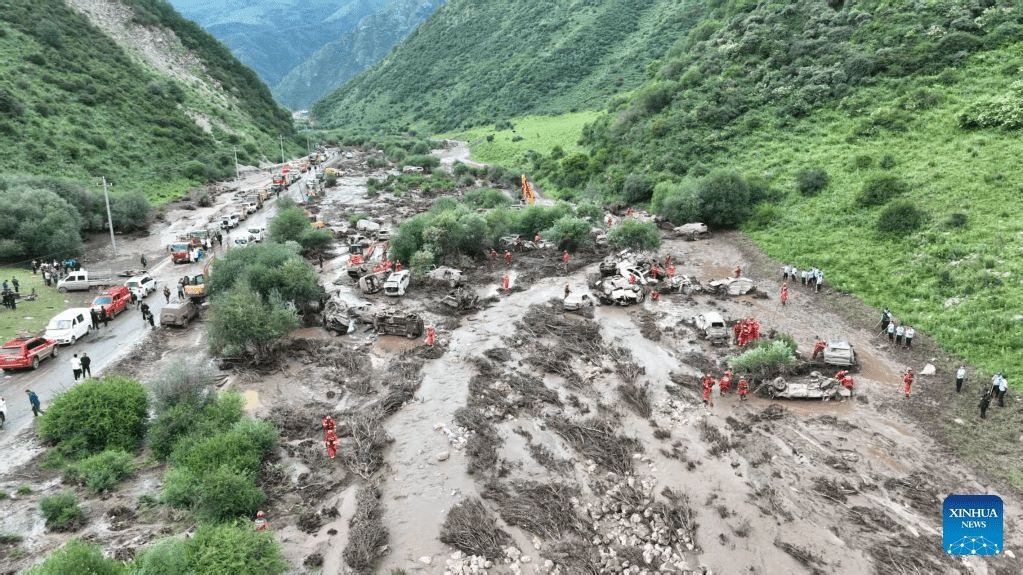
A catastrophic flash flood struck a popular tourist destination in northwest China's Gansu Province on Sunday afternoon, claiming at least 10 lives and leaving 23 others hurt in what authorities described as a rapidly deteriorating situation. The disaster unfolded in Weiyuan County within Dingxi City, where heavy rainfall descended with little warning, transforming scenic camping areas into death traps for holidaymakers. Local rescue officials mobilised public security and fire-and-rescue teams immediately, though the scale of the emergency stretched response capabilities as the afternoon progressed and casualty figures mounted.
The incident occurred as Typhoon Noul, the year's 12th tropical cyclone and the third major typhoon to strike China this month, carved a destructive path across the country's southern and central regions. The typhoon, whose name derives from a Korean term meaning the glow of sunrise or sunset, made landfall near Huidong county in Guangdong Province early Sunday morning at approximately 3:50 a.m., delivering gale-force winds and torrential precipitation to densely populated areas. The system continued to weaken as it progressed inland, yet meteorologists warned that associated rainfall patterns would intensify and persist through Tuesday, affecting swaths of territory from coastal Fujian to inland mountain provinces.
The scale of evacuation and displacement prompted by Noul underscores the severity of the weather event and China's preparedness frameworks. Authorities relocated more than 700,000 residents from vulnerable areas in Guangdong Province alone, a massive logistical undertaking reflecting the typhoon's classification as the year's strongest tropical cyclone. This figure illustrates both the concentration of population in storm-prone coastal zones and the government's commitment to precautionary evacuation protocols that, while economically disruptive, aim to prevent loss of life.
In response to the escalating threat, China's Ministry of Water Resources and China Meteorological Administration issued a highest-level red alert for flash floods, the most serious warning in the country's disaster alert system. The alert encompassed seven provinces and regions—Jiangxi, Hunan, Guangdong, Sichuan, Shaanxi, Gansu, and southeastern Xinjiang—reflecting the broad geographic footprint of Noul's rainfall impact. The red alert, in effect from Sunday evening through Monday evening, signalled to local governments and residents that conditions warranted the most vigorous emergency response measures and public precautions.
For Malaysian and Southeast Asian observers, the Gansu incident and Noul's progression carry important implications. Tropical cyclones spawned in the western Pacific exhibit similar formation mechanisms and behavioral patterns to storms affecting the region, and China's response strategies—particularly its evacuation protocols and real-time monitoring systems—offer instructive models for disaster management in densely populated areas. The coordination between national meteorological and water resources agencies demonstrates institutional approaches that transcend national borders in relevance.
Authorities issued detailed guidance to local governments, emphasizing vigilant oversight of flood-prone terrain including mountainous areas, river valleys, construction sites, and bridge infrastructure. These categories of vulnerability reflect both topographic realities and the challenges posed by rapid urbanisation and ongoing development projects that may themselves alter drainage patterns and flood dynamics. The specificity of warnings reflected lessons learned from previous disasters and an understanding that flash floods in particular demand rapid, localised response since water movement in confined valleys or constrained urban areas accelerates with limited warning.
Hong Kong, which experienced the typhoon's closest approach at approximately 80 kilometres away, endured powerful southwesterly gales that nonetheless fell short of the full destructive force experienced in mainland landing zones. The territory's Observatory cancelled all typhoon warning signals on Sunday evening, permitting the resumption of airport operations that had been suspended for more than 12 hours. This relatively rapid recovery reflected both the typhoon's inland progression and the maturity of Hong Kong's infrastructure and early-warning systems, factors that created meaningful divergence between the human toll in exposed Gansu and the manageable disruption in the more-protected financial hub.
The Gansu flash flood occurred in a scenic area frequented by tourists, many of whom were camping when the deluge arrived. The sudden nature of flash floods in mountainous or canyon terrain—where water accumulates and accelerates rapidly—creates particular danger for those unfamiliar with local hydrology or who underestimate precipitation rates during typhoon events. The trapped campers faced not only the immediate physical hazard of rising water but also the complications of rescue operations in terrain where vehicles and heavy equipment face severe access constraints.
Weather forecasters projected that rainfall would remain substantial through the middle of the week, with certain localities in Fujian Province facing extremely severe downpours that could rival or exceed the precipitation that triggered the Gansu catastrophe. The persistence of the threat underscored that Noul's danger extended well beyond the dramatic landfall moment, instead distributing risk across multiple days and numerous jurisdictions as the weakening system moved inland and redistributed its moisture burden.
China's response architecture, combining pre-event evacuation, real-time warning dissemination, and coordinated inter-agency alert protocols, reflects decades of experience managing tropical cyclone impacts across vast territories with varying topography and infrastructure development. The red alert issued to seven provinces activated pre-positioned resources and elevated alert status among local officials responsible for flood-prone communities. For the Gansu incident specifically, the challenge lay in the unpredictable nature of flash flooding in steep terrain, where even well-designed early-warning systems must contend with the speed at which water mobilises and the difficulty of providing meaningful reaction time to those in exposed locations.

