Authorities in Phu Tho province have successfully thwarted an ambitious cross-border scheme to establish a major online fraud operation on Vietnamese soil, with police charging four individuals over their roles in the conspiracy. The breakthrough came as regional governments intensify efforts to combat transnational cybercrime networks that have flourished in Southeast Asia, particularly those operating from Cambodia where enforcement has historically been inconsistent. The arrested group included Zhao Wei Zhong, a 37-year-old Chinese national identified as the primary architect of the relocation plan, along with three Vietnamese accomplices who provided logistical support for the proposed transfer.
The investigation originated when law enforcement detected suspicious activities linked to individuals with documented connections to established Chinese-run online fraud operations based in Cambodia. These existing scam centres have reportedly generated hundreds of millions of dollars through romance, investment, and lottery fraud schemes targeting vulnerable victims across Asia and beyond. When Cambodian authorities began escalating their own enforcement actions against these illegal call centres, the criminal networks apparently determined that relocating operations to a new jurisdiction offered the most viable path to continuing their illicit activities with reduced risk of disruption.
Zhao Wei Zhong's arrival in Vietnam marked the beginning of an elaborate groundwork operation. According to investigators, he had already accumulated substantial experience managing similar fraud facilities in Cambodia, where he established relationships with individuals who would later facilitate the Vietnamese branch of the operation. His specific mandate involved securing physical infrastructure, arranging accommodation for incoming staff members, and establishing the foundational logistics necessary to receive what authorities believed would be a significant influx of foreign workers drawn from existing Cambodian operations.
To execute this plan, Zhao strategically recruited two Vietnamese nationals, Tran Thi Thu Huong and Dình Nam, both originally from Bac Ninh province in the north. Their roles were deliberately complementary to Zhao's gaps in local knowledge and language capability. Huong, then 24 years old, and Nam, aged 27, provided translation services essential for communicating with local landlords and service providers, offered driving and transportation logistics, and conducted surveillance of potential properties where the fraud staff could be housed without raising suspicion. This division of labour reflects the sophisticated operational structure these international criminal networks employ to minimize detection while maximizing efficiency.
The conspiracy extended beyond the three core operatives. Investigators identified Nguyen Thanh Long, a 43-year-old Hanoi resident, as having provided crucial administrative and logistical coordination that supported the overall infrastructure development. His contributions, though less visible than those of the field operatives, proved essential in transforming Zhao's conceptual plan into concrete operational arrangements. The involvement of a locally-based, older Vietnamese facilitator suggests a well-established network of individuals within Vietnam sympathetic to or financially incentivized by foreign criminal enterprises, a pattern that has concerned regional security officials.
The authorities' swift intervention prevented the scam centre from ever becoming fully operational on Vietnamese territory. This proactive approach contrasts with situations where law enforcement discovers fraud operations only after they have been running for months or years, accumulating substantial victim losses. The timing of the arrests on June 17 followed what police described as a comprehensive evidence-gathering phase, indicating that investigators had conducted extensive surveillance and documentation of the conspiracy before making arrests.
The charging decisions reflect the Vietnamese legal system's treatment of various participants in the scheme. Zhao, Huong, and Long faced the most serious consequences, being charged with organising the illegal stay of foreigners in Vietnam and held in pretrial detention pending trial proceedings. Nam, despite his involvement in scouting and logistical support, received a notably less severe designation, placed under a movement restriction order that prohibited him from leaving his residence but allowed him to remain outside custody. This differentiation may reflect either his more limited role in the conspiracy or other mitigating factors that prosecutors considered significant.
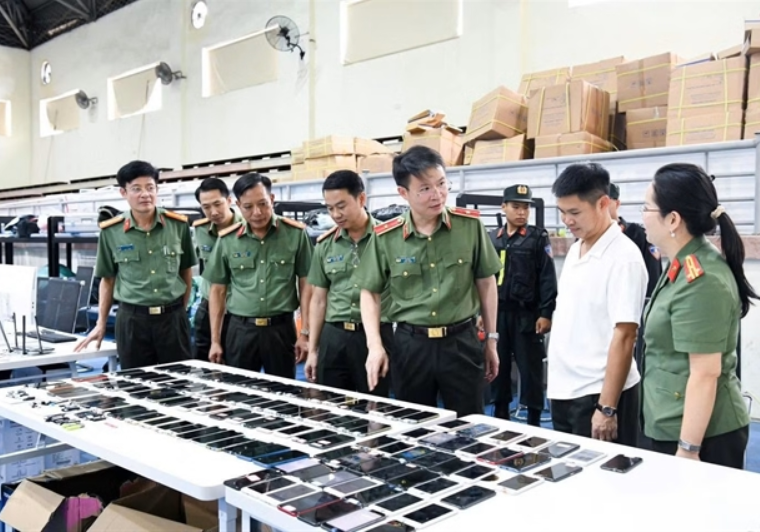
The physical evidence seized from properties associated with the suspects provides striking insight into the scale and sophistication of the planned operation. Police recovered 73 computers, 134 mobile phones, 34 USB drives, and 20 Wi-Fi routers, equipment specifically configured for operating a large-scale call centre serving international fraud schemes. The quantity of devices suggests planners anticipated accommodating dozens of call centre workers simultaneously, capable of managing thousands of victim interactions daily across multiple time zones and languages. Such infrastructure investments represent substantial capital commitments, underscoring the financial viability and profitability of these criminal enterprises.
This case illuminates the volatile dynamics of transnational organized crime in Southeast Asia, where criminal groups maintain flexibility to relocate operations when enforcement pressure increases in particular jurisdictions. The movement from Cambodia to Vietnam demonstrates how the region's relatively porous borders and varying enforcement capacities create opportunities for criminal entrepreneurs to arbitrage differences in regulatory environments. For Malaysia and other ASEAN nations, the implications are significant, as similar relocation threats may emerge as governments tighten controls on such activities.
The successful disruption also underscores the importance of proactive intelligence gathering and cross-border cooperation among regional law enforcement agencies. Vietnamese authorities detected suspicious patterns indicative of criminal planning before the operation became fully established, reflecting enhanced investigative capacity focused on cybercrime networks. As these schemes increasingly target victims throughout Southeast Asia and beyond, developing effective mechanisms for information sharing and coordinated enforcement becomes increasingly critical.
The broader context reveals that while individual prosecutions represent important victories, addressing the underlying structure of transnational fraud operations requires sustained pressure across multiple jurisdictions simultaneously. The availability of Cambodia as a safe haven for initial operations, combined with the relative ease of relocating to nearby countries, creates a cyclical pattern where dismantling one centre merely displaces the problem rather than eliminating it. For Malaysian authorities and other regional law enforcement, this case serves as both a cautionary tale and a template for identifying similar conspiracies during their planning stages rather than after becoming entrenched.

