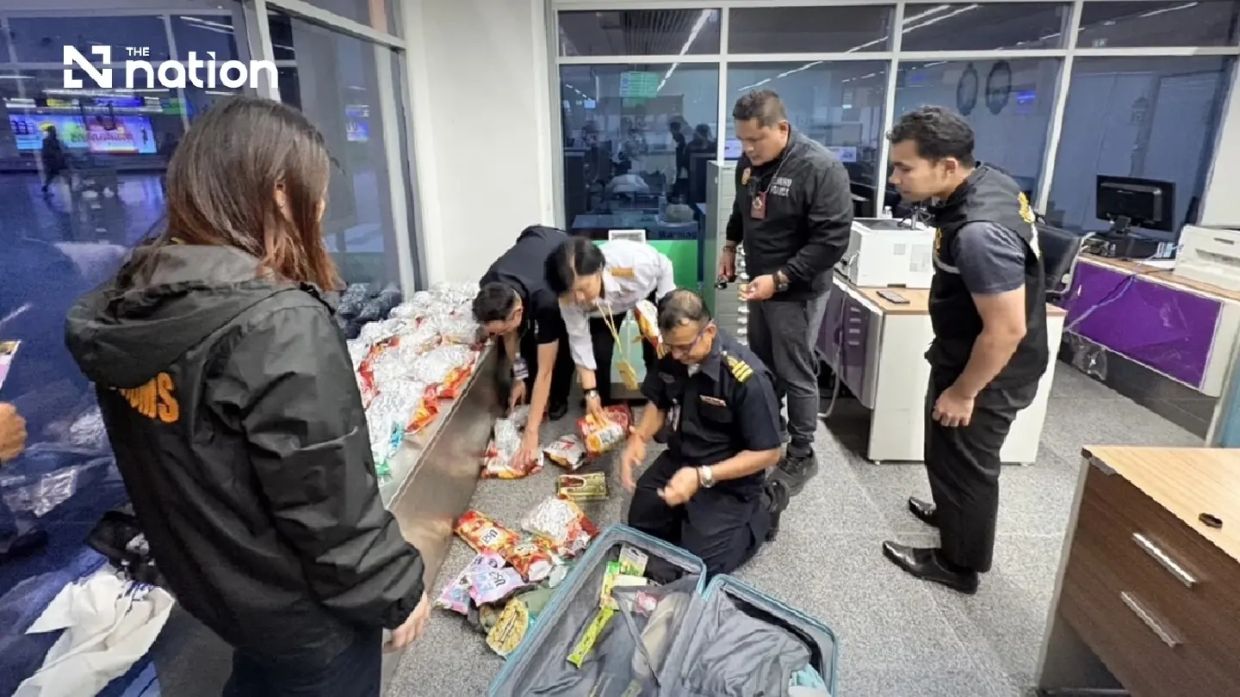
A 30-year-old Russian national faced arrest at Phuket International Airport on Wednesday, July 8, when Thai customs authorities uncovered a substantial quantity of cannabis packed within his departure luggage. The discovery came as the man prepared to exit Thailand through the international terminal, triggering an immediate law enforcement response that would ultimately result in charges related to attempted smuggling across the kingdom's borders.
The interception occurred within the international departure facility located in Mai Khao subdistrict, Thalang district. Customs officer Rawin Kanokakorn led an inspection team that scrutinised two blue BP WORLD wheeled suitcases belonging to Sergei Chalabari. The combined weight of the luggage initially registered at eight kilogrammes, a figure that would soon reveal a carefully concealed payload beneath innocent-seeming outer layers.
Systematic searching by the customs team exposed the true contents of Chalabari's baggage. Inside the suitcases, officers extracted 35 vacuum-sealed packages containing cannabis flowers totalling 11.4 kilogrammes in gross weight. The seizure also included 12 packages of cannabis resin weighing 6.2 kilogrammes combined, bringing the total contraband haul to 17.6 kilogrammes. The meticulous packaging suggested deliberate preparation for international transportation, with vacuum-sealing designed to mask both odour and visibility during routine airport screening.
Initial questioning produced a straightforward admission from the suspect. Chalabari acknowledged ownership of both the suitcases and their illicit contents, providing investigators with a clear confession that simplified the legal groundwork. This acknowledgment eliminated potential complications regarding possession and intent that often characterise such cases. The confession also allowed authorities to move swiftly through preliminary procedures and escalate the matter to formal charges.
Prosecutors classified the alleged offence as attempted smuggling of goods out of Thailand without observance of customs procedures, a serious charge that carries substantial penalties under Thai drug legislation. The distinction of attempting to remove contraband distinguishes this case from simple possession offences, indicating premeditation and intention to transport controlled substances across international boundaries. Thailand maintains some of the region's strictest drug enforcement policies, and violations involving significant quantities typically result in lengthy imprisonment.
The suspect's detention followed immediately after the customs discovery, with authorities transferring Chalabari to Sakhu Police Station for formal processing and investigation. The suitcases themselves were retained as evidence, their physical characteristics and contents now integral to the prosecution file. The transfer initiated a chain of custody procedure designed to preserve evidence integrity throughout subsequent legal proceedings.
Multiple layers of Thai law enforcement oversaw the operation, reflecting the seriousness with which authorities treat drug-related offences at international gateways. Pol Col Salan Sankhisasanakun, superintendent of Sakhu Police Station, and Pol Lt Col Rattanawut Nukaew, deputy superintendent for investigation, supervised the police response. On the customs side, Nucha Jeeradit, chief of the Phuket Airport Customs House, coordinated the seizure alongside Thanomjit Burirak, director of the customs control division, and Charoenporn Jaengwansuk, chief of the investigation and suppression section.
Phuket's international airport serves as a major transit hub for Southeast Asian travel, processing hundreds of thousands of passengers monthly from dozens of nations. The facility's customs infrastructure incorporates both random screening and intelligence-driven searches, allowing officers to intercept contraband before it departs Thai airspace. This particular discovery underscores the effectiveness of those detection systems, particularly regarding concealment methods that might evade less rigorous scrutiny.
The incident reflects broader patterns of drug trafficking through Southeast Asian airports. Foreign nationals, often from Eastern Europe and Central Asia, have featured prominently in cannabis seizures across the region during recent years. Phuket specifically has witnessed several comparable cases, suggesting the destination attracts individuals attempting to exploit the island's accessibility and tourism infrastructure for smuggling operations. Thai authorities have responded by enhancing screening protocols and cooperation between customs and police units.
For Russian nationals and other foreign visitors, the case serves as a stark reminder of Thailand's uncompromising approach to drug enforcement. Possession of even small quantities of controlled substances can result in years of imprisonment, while trafficking and smuggling offences carry sentences measured in decades. The kingdom's legal framework distinguishes little between major traffickers and individuals attempting to transport contraband, applying consistent penalties regardless of quantity or circumstance.
The operational success also highlights cooperation between Thailand's customs and police institutions at ports of entry. Inter-agency coordination has intensified across Southeast Asia as governments recognise that drug interdiction requires sustained collaboration and information sharing. Phuket Airport's role as a critical chokepoint for outbound trafficking makes such cooperation particularly valuable, allowing authorities to intercept materials before they reach international markets where they might reach vulnerable populations.
Chalabari's case will progress through Thai criminal courts, where he faces prosecution under drug smuggling statutes that typically provide limited flexibility for sentencing reductions. The confession element may offer marginal mitigation, though Thai judges generally impose substantial custodial sentences for cannabis trafficking cases involving such quantities. The outcome will likely involve several years of imprisonment, followed by possible deportation upon release.

