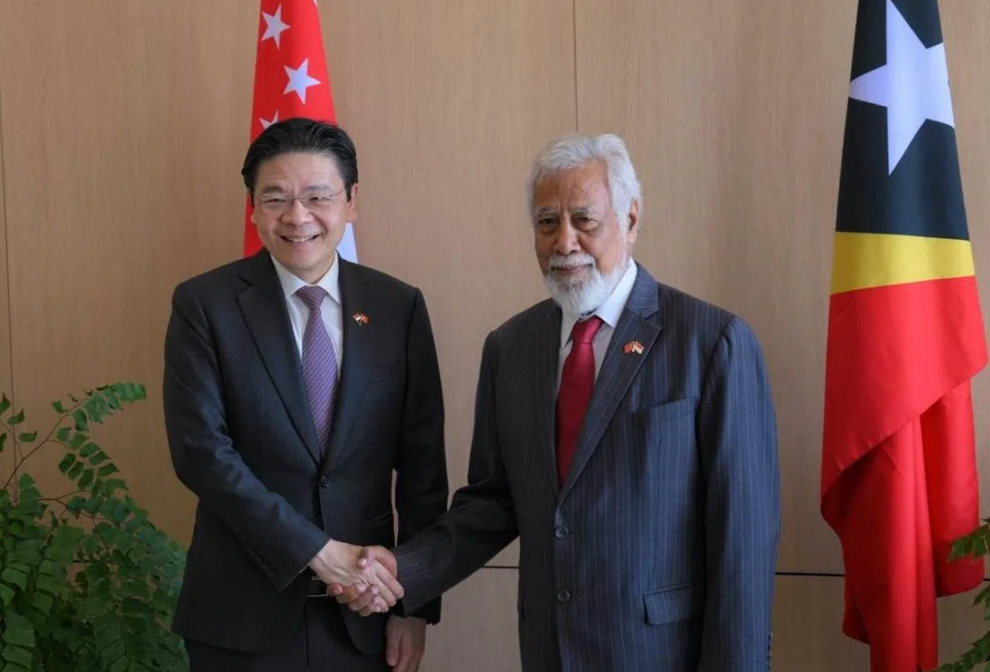
Prime Minister Lawrence Wong's first visit to Timor-Leste as a Singapore leader marks a significant deepening of ties between the two Southeast Asian neighbours, with both nations committed to expanding economic cooperation and building institutional capacity across multiple sectors. During the two-day trip to Dili, Singapore and Timor-Leste formalised their commitment through a comprehensive bilateral cooperation framework signed on July 3 at the Government Palace, witnessed by PM Wong and his counterpart PM Xanana Gusmao. The agreement establishes formal mechanisms for sustained engagement between the foreign ministries, creating structures for regular dialogue on bilateral matters alongside regional and strategic issues affecting both nations.
The timing of this diplomatic initiative carries particular significance for Timor-Leste, which officially joined the Association of Southeast Asian Nations in October 2025 after years of pursuit. As a new member still consolidating its position within ASEAN, the country benefits substantially from Singapore's institutional knowledge and technical expertise. PM Wong explicitly framed the partnership around a philosophy both nations share: that size need not dictate strategic influence, and that small countries can chart independent courses through strategic partnerships and determined effort. This messaging resonates with Timor-Leste's own journey as a young nation seeking to establish itself on the regional stage.
On the investment front, Singapore companies already rank among the largest foreign investors in Timor-Leste, with interests spanning wholesale trade, renewable energy, and other emerging sectors. The expansion of economic engagement reflects genuine business confidence in Timor-Leste's development trajectory, moving beyond traditional extractive industries towards broader economic diversification. By positioning itself as a partner in this diversification process, Singapore stands to benefit from first-mover advantages while Timor-Leste gains access to capital, expertise, and markets critical for sustainable growth. PM Wong's messaging emphasized that expanded cooperation creates mutual benefits—new business opportunities for Singapore firms while generating employment and economic growth for Timorese communities.
Perhaps the most immediately tangible announcement concerns labour mobility. From the second half of 2027, Singapore will designate Timor-Leste as a non-traditional source for work permit holders in construction, marine shipyard, and related sectors facing labour constraints. This represents a pragmatic response to Singapore's structural manpower challenges while creating genuine employment pathways for Timorese workers. The Singapore Ministry of Manpower has already observed early interest from construction firms, suggesting the programme will fill genuine labour gaps. For Malaysian and other regional observers, this move illustrates Singapore's willingness to expand labour sourcing beyond traditional suppliers, potentially signalling competitive pressure on existing worker-source relationships and shifting regional migration patterns.
Healthcare cooperation represents another substantive pillar of the expanded partnership. The National University Hospital and Timor-Leste's health ministry intend to establish a five-year collaborative framework addressing priority areas identified by Dili's health authorities. The partnership will span health workforce development, emergency care, paediatrics, ophthalmology, obstetrics and gynaecology, and foundational supportive care systems. This targeted approach reflects realistic assessment of Timor-Leste's institutional development stage—rather than generic knowledge transfer, the collaboration focuses on building capacity in areas directly impacting health outcomes for the Timorese population. For Malaysia and other Southeast Asian nations, such south-south cooperation models demonstrate how developed ASEAN members can support newer or less developed peers without imposing prescriptive solutions.
Education capacity building similarly targets institutional development, with Singapore supporting efforts to strengthen Timor-Leste's teacher training and educational leadership systems. The focus on nurturing school leaders addresses a critical bottleneck in education quality—the shortage of capable administrators and educators prepared for institutional leadership roles. This aligns with broader Southeast Asian development priorities, where education quality often constrains progress regardless of infrastructure investments. Singapore's experience developing educators across diverse institutional contexts provides practical value beyond simple financial assistance.
Timor-Leste's recent ASEAN accession introduced new strategic imperatives, particularly preparation for the chairmanship role scheduled for 2029. PM Wong announced significant expansion of the Singapore-Timor-Leste ASEAN Readiness Support (STARS) package, originally launched in December 2022. The enhanced programme includes tailored workshops on ASEAN chairmanship responsibilities and opportunities for Timorese officials to participate directly in Singapore's 2027 chairmanship team operations. This sequencing—drawing on Singapore's fresh experience as 2027 chair while preparing Timor-Leste for its 2029 turn—demonstrates sophisticated regional institution-building. For Malaysian readers familiar with ASEAN's operational complexities, such practical mentorship proves far more valuable than formal training, as it exposes emerging member officials to real-time decision-making and coordination challenges.
PM Gusmao's characterization of Singapore as a "trusted friend and partner" reflects Timor-Leste's strategic calculation that advanced ASEAN members offer critical support for consolidating membership benefits. Timor-Leste's journey to ASEAN membership involved sustained diplomatic effort, and acceleration of substantive cooperation with established members reinforces the membership value proposition. For regional observers, this pattern suggests ASEAN's newest members will seek closest partnerships with well-resourced members capable of providing capacity building—a dynamic affecting intra-ASEAN power relationships and development patterns.
PM Wong's receipt of the Order of Timor-Leste (Grand Collar) from President Jose Ramos-Horta acknowledges Singapore's consistent support for Timorese nation-building, from bilateral capacity programmes to ASEAN sponsorship. Wong's acceptance speech redirected credit to Singaporean professionals and institutions conducting this work—emphasizing that capacity building reflects organizational commitment rather than individual diplomatic gesture. This framing matters because it suggests the partnership rests on institutional foundations rather than personality-dependent relationships, increasing durability and sustainability.
The broader context for this partnership involves Timor-Leste's strategic positioning in an increasingly contested Indo-Pacific region. As a new ASEAN member located at the eastern frontier of the organization and possessing significant maritime resources, Timor-Leste navigates complex geopolitical currents. Deepening partnerships with Singapore—a staunch ASEAN institutionalist and established economic power—provides Dili with an anchor relationship offering economic benefits, capacity building, and political support without the complications attending relationships with major powers. For Malaysian policymakers observing ASEAN dynamics, Singapore's approach to supporting emerging members through practical cooperation rather than political pressure offers instructive lessons.
The labour exchange programme deserves particular attention as it signals workforce mobility patterns within Southeast Asia. Malaysian construction and marine shipyard sectors already compete with Singapore for workers from regional sources. Expansion of Timorese worker access to Singapore markets could affect wage dynamics and worker availability across the region, particularly if successful recruitment demonstrates Timorese workers' suitability for skilled positions. For Malaysian employers, the policy announcement warrants monitoring as expanding labour mobility within ASEAN creates both competitive pressures and potential opportunities.
Looking forward, the most significant implications concern Timor-Leste's trajectory within ASEAN and the region's development architecture. Successful implementation of healthcare, education, and ASEAN readiness programmes will substantially influence whether Timor-Leste can transform its recent accession into genuine institutional participation rather than nominal membership. Singapore's commitment to this outcome—demonstrated through resource allocation, high-level engagement, and structured programmes—suggests confidence in Timor-Leste's capacity to contribute meaningfully to regional cooperation. For Southeast Asia more broadly, whether newer members successfully consolidate ASEAN participation affects the organization's future coherence and relevance.
The visit and agreements announced represent strategic investment by Singapore in regional institution-building and Southeast Asian stability. By supporting Timor-Leste's successful ASEAN integration, Singapore reinforces ASEAN's collective standing and demonstrates the organization's capacity to accommodate new members constructively. For Malaysia and other established ASEAN nations, Singapore's systematic approach to welcoming Timor-Leste offers a model for balancing genuine support with strategic interest—capacity building that serves both the new member and the organization's long-term interests. As geopolitical competition intensifies in Southeast Asia, such cooperation among ASEAN members provides ballast against external pressures and demonstrates the organization's continued relevance as a forum for practical development partnership.

