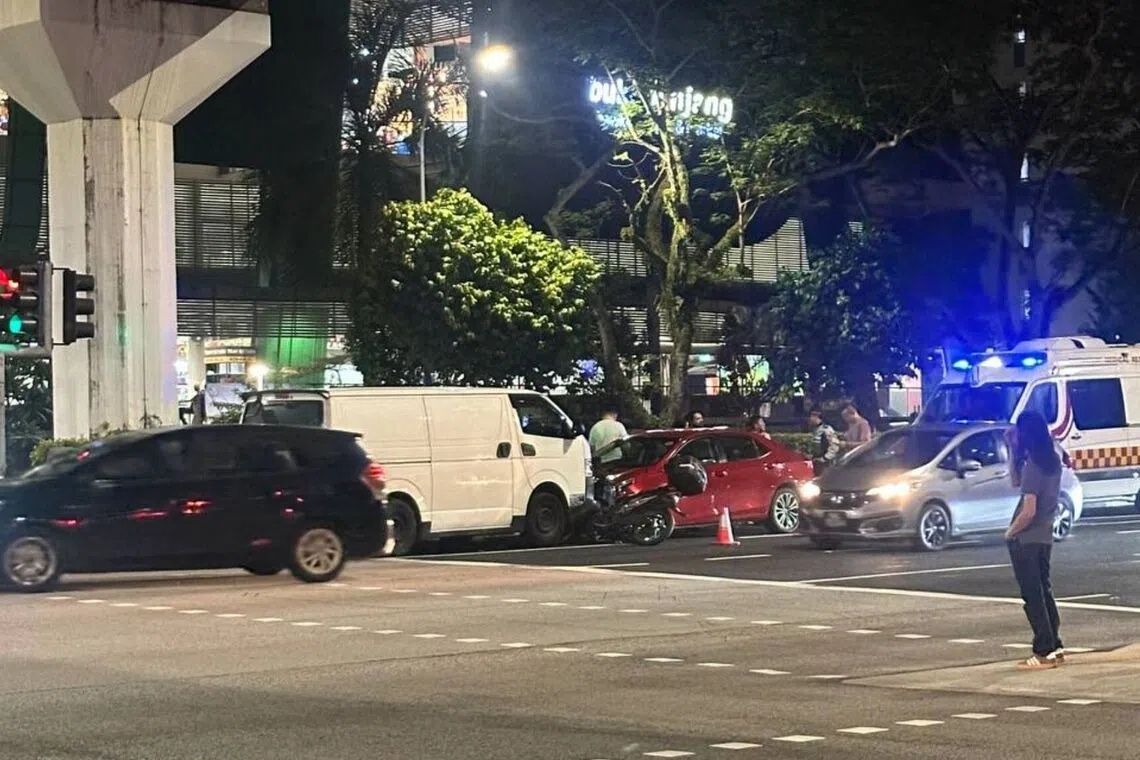
A 27-year-old van driver remains in police custody after a serious multi-vehicle collision on Bukit Panjang Road on Friday evening, with authorities alleging he was operating the vehicle whilst impaired by drugs. The incident, which unfolded around 9pm near the intersection with Bukit Panjang Ring Road, involved five separate vehicles and left two individuals with minor injuries who declined hospitalisation. The circumstances surrounding the crash have raised fresh concerns about substance impairment and road safety in Singapore's suburban areas.
Emergency services received the alert shortly after the collision occurred, with both the Singapore Civil Defence Force and police responding swiftly to the scene. Initial reports indicate that the van was travelling counter to the normal flow of traffic at the time of impact, suggesting either driver error or incapacity at the controls. Eyewitness footage subsequently shared on social media platform Instagram by account sgfollowsall captured the violent aftermath, showing the van positioned nose-to-nose with a red sedan, with a motorcycle wedged between the two vehicles. A black sedan could be observed metres behind the red vehicle, its position suggesting a cascading collision sequence.
During their investigation, police officers conducting a search of the van recovered two vaporising devices along with three associated pods, prompting immediate concern over their contents and potential relationship to the driver's impairment. The seizure of these items represents an escalating pattern of concerns regarding vaping products in Singapore, particularly when associated with controlled substances. The discovery has been formally referred to the Health Sciences Authority for comprehensive analysis and determination of whether the devices contain prohibited drugs or their analogues, which remain tightly controlled under Singapore's stringent narcotics legislation.
The arrest itself focuses on allegations of driving under the influence of drugs, a charge that carries considerable legal weight under Singapore law. This offence is treated with particular severity by authorities, as impaired driving fundamentally endangers public safety and represents a deliberate breach of road regulations. The specific substances involved remain under investigation, though the presence of vaporising equipment suggests potential involvement of inhalant-based drugs rather than conventional tablets or powder forms. Such devices have increasingly become vectors for delivering prohibited substances whilst potentially evading conventional detection methods.
The multi-vehicle nature of this incident underscores how single impaired drivers can trigger catastrophic chain-reaction collisions affecting numerous innocent parties. In this case, the involved vehicles ranged from a motorcycle—representing the most vulnerable road user category—through to multiple private automobiles. The fact that only minor injuries resulted represents a degree of fortune rather than inevitability, particularly given the apparent severity of the initial impact between the van and red sedan. Had circumstances been marginally different, fatalities could easily have resulted from this configuration of vehicles and speeds.
For Malaysian observers, this incident carries particular relevance given comparable road safety challenges across the Causeway and throughout Southeast Asia more broadly. Drug-impaired driving remains an underreported yet significant contributor to serious traffic accidents throughout the region, with detection and prosecution often lagging behind public health imperatives. Singapore's swift response and comprehensive investigation protocols offer a model of systematic enforcement, though regional authorities throughout Malaysia and other neighbouring countries could benefit from similarly rigorous approaches toward drivers suspected of substance impairment. The integration of chemical analysis, forensic investigation, and coordinated enforcement demonstrates institutional capacity that remains inconsistently applied elsewhere in Southeast Asia.
The involvement of vaporising devices specifically highlights an emerging enforcement challenge across multiple jurisdictions. As vaping technology becomes increasingly sophisticated and miniaturised, the potential for misuse in delivering prohibited substances grows correspondingly. Regulatory frameworks that successfully managed traditional smoking patterns have proven less nimble in addressing this evolving landscape, creating enforcement gaps that producers and distributors of illicit products actively exploit. Singapore's Health Sciences Authority involvement demonstrates recognition that technological sophistication requires equally sophisticated analytical responses rather than generic assumptions about device contents.
Investigations remain ongoing as police continue gathering evidence and conducting interviews with involved parties and potential witnesses. The two individuals who sustained minor injuries but declined hospital treatment may still provide crucial testimony regarding the collision sequence, driver behaviour immediately preceding impact, and any observable signs of impairment. Such witness accounts frequently prove decisive in establishing probable cause and supporting prosecution arguments, particularly when corroborated by physical evidence from the scene, vehicle damage patterns, and toxicological analysis.
The broader implications of this incident extend beyond the immediate criminal investigation. It reinforces the critical importance of consistent enforcement of drug-driving legislation, comprehensive public education regarding impairment risks, and technological investment in detection capabilities. Road safety represents a shared societal interest transcending national boundaries, with lessons from one jurisdiction's experience offering valuable guidance for policymakers and law enforcement agencies elsewhere. Singapore's approach, combining rapid response, comprehensive evidence collection, and systematic analysis, provides a benchmark against which other Southeast Asian nations might evaluate their own capabilities and protocols for addressing similar offences.

