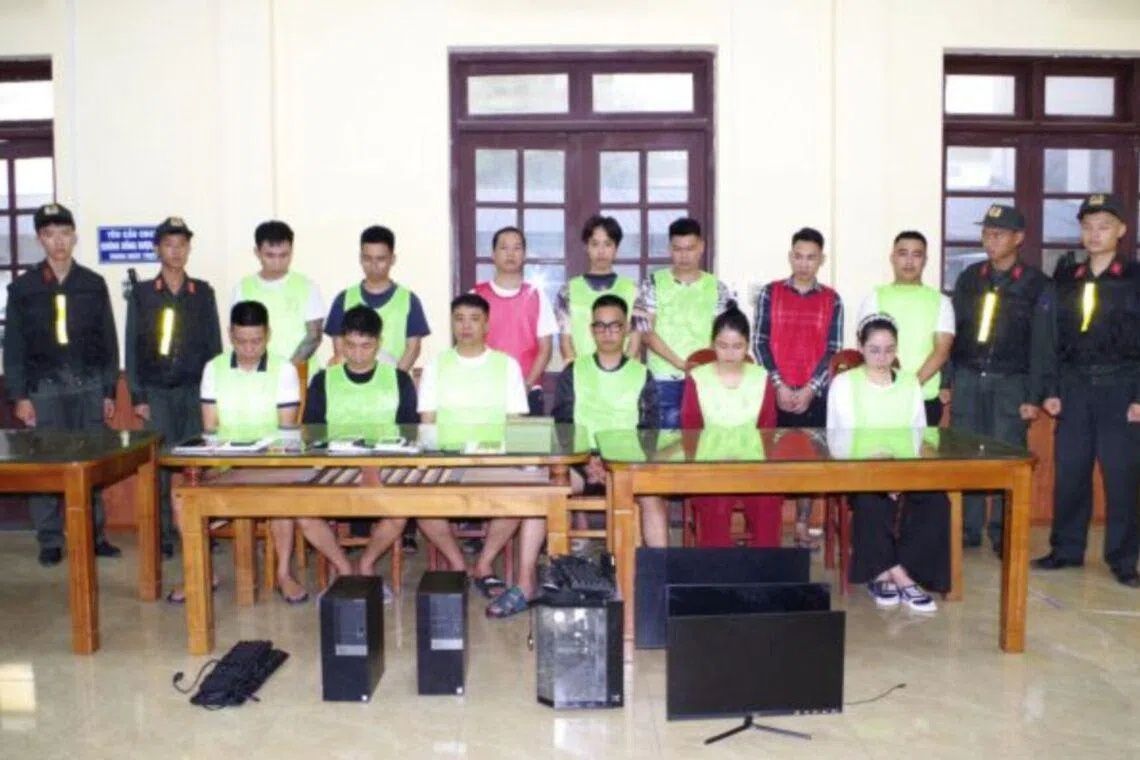
Law enforcement authorities in Vietnam's northern Ninh Binh province have successfully dismantled a complex transnational cyberfraud operation, resulting in the arrest of 12 suspects believed responsible for defrauding victims of more than 250 billion dong, equivalent to RM39.2 million. The breakthrough came after an intensive investigation that uncovered an elaborate criminal network spanning multiple countries and employing highly coordinated scamming tactics designed to exploit unsuspecting targets across Vietnam.
Investigators identified Nguyen Van Cuong, 28, and Nguyen Van Phuong, 34, as the principal masterminds directing the criminal enterprise. Their operation showcased hallmarks of professional cybercrime, with law enforcement seizing extensive evidence during raids conducted across the province. Officers recovered substantial cash holdings, a motor vehicle, numerous mobile phones and computers, fraudulent identity documents, jewellery, and comprehensive records documenting the network's criminal activities.
The criminal structure reveals a systematically organised operation that extended beyond Vietnam's borders. Authorities determined that the suspects had recruited multiple Vietnamese nationals and arranged their transportation to Cambodia, where the group maintained operational headquarters. This cross-border arrangement provided the gang with geographical insulation while enabling them to manage their sophisticated fraud operations targeting primarily Vietnamese citizens. The hierarchical organisation featured clearly delineated roles and responsibilities, indicating a level of professionalism rarely seen in typical online fraud cases.
Central to the network's effectiveness was their deployment of deceptive impersonation tactics. Gang members posed as official representatives from various government institutions, including police officers, prosecutors, judges, and tax officials. They also impersonated employees from the banking sector, lending credibility to their demands for financial information and monetary transfers. These identity thefts proved particularly effective because victims naturally hesitate to question the legitimacy of authority figures requesting information or funds.
Technological sophistication formed another cornerstone of their fraudulent methodology. The group invested considerable resources in creating counterfeit digital platforms, developing fake websites and mobile applications designed to replicate authentic government agency portals and legitimate business platforms. These fraudulent interfaces were engineered with sufficient authenticity to deceive victims into believing they were conducting transactions with genuine entities, thereby significantly increasing the likelihood of successful fraud completion.
The network deployed multiple overlapping scam scenarios to maximise their success rate and evade detection. They circulated fabricated employment opportunities targeting individuals seeking part-time work arrangements, then extracted advance fees or personal financial information from interested applicants. They simultaneously operated fraudulent investment schemes promoting opportunities in financial markets, securities trading, and cryptocurrency ventures, luring victims with promises of substantial returns. The group also engaged in romance scams, where operatives cultivated fake romantic relationships with targets before requesting money for various fabricated emergencies or investment opportunities.
Another revenue stream involved social media account hijacking, whereby the gang gained unauthorised access to victims' social media profiles and subsequently leveraged their digital connections to solicit loans from the victims' online contacts. Additionally, the gang executed an ingeniously conceived scheme whereby members impersonated military officers and contacted shops and business establishments to place sizeable merchandise orders. They then persuaded these business owners to purchase additional inventory on their behalf and remit deposits or advance payments to designated bank accounts controlled by the fraudsters, effectively appropriating funds intended for legitimate business transactions.
The scope of victimisation was substantial. Beginning in October 2024, the criminal network systematically targeted approximately 500 separate victims throughout Vietnam, accumulating over 250 billion dong through their multi-faceted scamming operations. This concentration of victims over a relatively brief operational window underscores both the efficiency and the predatory nature of the gang's criminal enterprise. The diversity of scam types deployed suggests the perpetrators had thoroughly researched victim vulnerability patterns and tailored their approaches accordingly.
Criminal proceedings have already commenced against six of the detained suspects, who face charges of fraudulent appropriation of property. These individuals remain in temporary detention pending further judicial proceedings. The remaining six suspects are subject to procedural measures as the police investigation continues to develop. Investigators are actively pursuing additional members of the criminal network believed to still be at large, indicating that the 12 arrests represent only a partial dismantling of the broader operation.
Authorities are pursuing asset recovery strategies consistent with Vietnamese law, attempting to freeze and confiscate funds and properties acquired through the fraudulent scheme. These recovery efforts aim to restore funds to defrauded victims whilst simultaneously eliminating the financial incentives that sustain organised cybercrime networks. The investigation underscores the transnational nature of modern cybercrime and highlights the necessity for coordinated regional law enforcement cooperation to effectively counter such operations. For Malaysian residents, this case serves as a cautionary reminder of the increasingly sophisticated tactics employed by cross-border fraud networks operating throughout Southeast Asia, and the importance of exercising heightened vigilance when encountering unsolicited communications from individuals or entities claiming official status.

